 Free toolEmbroidery machine finderThree questions about what you'll embroider, and the machine models that fit, from their specs.Open the tool
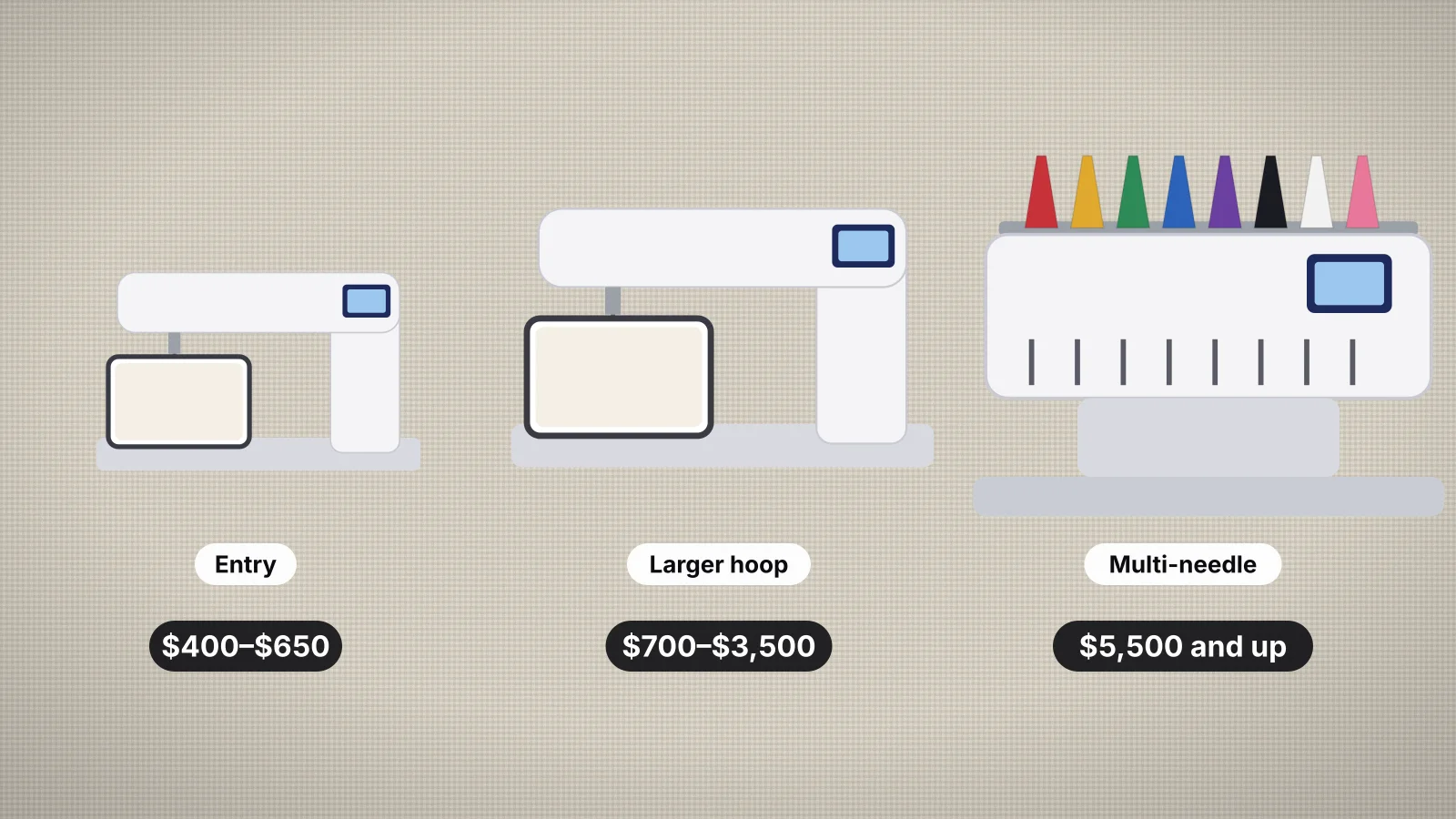
Embroidery machine prices run from a few hundred dollars to the price of a car, and the gap comes down to two things: how big a design the machine can sew in one hooping, and how many needles it has. A 4 × 4 in combo machine for names and small gifts and a 15-needle commercial machine for caps and team orders are different tools for different jobs.
This guide gives typical 2026 US street prices for each kind of machine, with examples, plus what it costs to run one, when a used machine makes sense and which kind to buy for your goal. Prices were checked against makers' and retailers' listings in November 2026. They move with sales, bundles and tariffs, so treat them as ranges and check a dealer before you buy.
How much does an embroidery machine cost by type?
The largest embroidery field and the number of needles set the price band. Within a band, the screen, wireless transfer, built-in designs and dealer bundles move the price up or down.
| Kind of machine | Largest field | Typical new price | Examples, about |
|---|---|---|---|
| Entry single-needle | 4 × 4 in (100 × 100 mm) | About $400–$650 | Brother SE630 $430–$550, SE700 $540–$620, SE725 $550 |
| Mid-size single-needle | 5 × 7 in (130 × 180 mm) or similar | About $800–$1,500 | Singer SE9180 $800–$1,100, Brother PE900 $1,000–$1,200, Brother SE2000 $1,500 |
| Large-hoop single-needle and combos | About 6 × 10 in to 8 × 12 in | About $700–$3,500 | Singer Legacy SE300 $700–$1,100, Brother NQ1700E $2,000–$2,300, Brother NQ3550W $2,600–$3,000 |
| High-end home | 9.5 × 14 in and up | About $7,500–$25,000 | Brother Stellaire XE2 $7,600–$8,500, PFAFF creative icon 2 $18,000, Brother Luminaire XP3 $21,000 list, Brother Aveneer EV1 $23,500–$25,000 |
| Home and prosumer multi-needle | About 8 × 12 in, with 6–10 needles | About $5,500–$13,000 | Ricoma EM-1010 from $5,500, Janome MB-7 $6,000, Brother PR680W $12,600–$13,000 |
| Commercial single-head | Up to about 20 × 14 in, with 15 needles | About $11,000–$16,000 | Ricoma MT-1501 $11,400–$13,000; Tajima, Barudan and Melco price through dealers |
| Commercial multi-head | 2 to 12 heads | About $14,000–$67,000 or more | Ricoma lists a 2-head from about $14,200, a 4-head at about $26,000, a 6-head at about $37,000 and a 12-head at about $67,000 |
The examples are typical US prices at the makers and large retailers in November 2026, often sale prices. Some models are discontinued and selling out, such as the Brother SE600 and PE800, so their prices drop and then they disappear. Dealer bundles can add hoops, thread, software or classes, so compare what's in the box, not just the price.
What does a $400–$1,500 machine get you?
An entry machine sews designs up to 4 × 4 in or 5 × 7 in, one color at a time. You rethread at every color change, which is fine for names, monograms, small logos and gifts, and slow for a 24-piece order with five colors.
- 4 × 4 in, about $400–$650, fits names, monograms, baby items and small logos. Many are sewing and embroidery combos, such as the Brother SE630 and SE700.
- 5 × 7 in, about $800–$1,500, fits most home projects: towel names, tote designs and left chest or cap-sized logos with room to spare. The Brother PE900 is embroidery-only; the SE2000 also sews.
- What you give up: design size, speed, cap and tubular hooping, and automatic color changes. Most also have smaller screens and fewer hoops in the box.
- What you get: a USB stick port on almost every current model, and wireless transfer on many. The 4 × 4 in and 5 × 7 in machine lists compare each model's field, formats and transfer.
For a first machine, buy the largest field you can afford: a 5 × 7 in machine costs a few hundred dollars more than a 4 × 4 in one and does far more. The best embroidery machine for beginners covers the trade-offs model by model.
Try it with your own design
Sign up free, upload an image and get a stitch preview in under a minute.
Drop your image here
PNG, JPG, SVG, PDF or AI · stays on your device
Not sure what to expect? See real examples or how it works.
What do you pay for in large-hoop and high-end machines?
Above about $2,000 you're paying for a bigger field, fewer rehoopings and a nicer machine to work at. Large single-needle machines with a 6 × 10 in field, such as the Brother NQ1700E, sew bigger designs and quilt blocks in one hooping.
- Field size. High-end machines reach 9.5 × 14 in on the Brother Stellaire XE2, 10 5/8 × 16 in on the Luminaire XP3 and 17 3/4 × 17 3/4 in on the Husqvarna Viking Designer Epic 3, which dealers list at about $19,000–$24,000.
- Sewing and quilting. Most flagship machines are full sewing and quilting machines too, with wide throats and hundreds of stitches, and that's much of their price.
- Screens, cameras and wireless. Large touchscreens, design editing on the machine, cameras or projectors for placement, and Wi-Fi.
- Dealer support. Many are sold through dealers with classes, service and trade-in offers, which is worth something on a machine at this price.
If you mainly want large designs and not the sewing features, an embroidery-only machine with a large field costs much less than a flagship combo. The large-hoop machine list shows the biggest fields drawn to scale.
How much do multi-needle and commercial machines cost?
A multi-needle machine holds a thread on each needle and changes colors itself, and most take cap frames and tubular hoops for bags and sleeves. That's what makes small runs of hats, team gear and logo wear practical, and it's why prices start at about $5,500.
| Machine | Needles | Largest field | Typical price |
|---|---|---|---|
| Ricoma EM-1010 | 10 | 310 × 210 mm (12.2 × 8.3 in) | From about $5,500; larger packages cost more |
| Janome MB-7 | 7 | 240 × 200 mm (9.4 × 7.9 in) | About $6,000 |
| Brother PR680W | 6 | 200 × 300 mm (8 × 12 in) | About $12,600–$13,000 |
| Ricoma MT-1501 | 15 | 500 × 360 mm (19.7 × 14.2 in) | About $11,400–$13,000 |
| Ricoma multi-heads | Varies by model | Per head | About $14,200 for 2 heads to about $67,000 for 12 |
Commercial brands such as Tajima, Barudan, Happy and Melco mostly sell through dealers and quote on request. Ask whether shipping, installation, training and software are included, because they often aren't, and compare financing offers, which are common at this level. Single vs multi-needle machines explains the difference in daily work, and the multi-needle machine list compares models side by side.
What does it cost to run an embroidery machine?
After the machine, plan for supplies, hoops, designs and servicing. For a typical left chest logo, thread, backing, needles and bobbin thread come to well under $0.50 a piece, but the starter kit and the extras add up.
| Cost | Typical price | Notes |
|---|---|---|
| Embroidery thread | About $3.50–$6 per 1,100 yd spool; about $13–$20 per 5,000 m cone | Start with 20–40 colors; cones suit multi-needle machines |
| Stabilizer | About $15–$30 a roll | Tear-away, cut-away and water-soluble; knits need cut-away |
| Needles | About $5–$8 for a pack of 5 | Many embroiderers change them every 8–10 hours of stitching |
| Bobbin thread | Small | Buy prewound bobbins or thread in the size your machine takes |
| Extra hoops | Varies; Brother's magnetic frames start at about $95 for a 3 × 3 in frame, and larger ones cost more | Magnetic hoops speed up hooping thick or awkward items |
| Designs and digitizing | Free and purchased designs; software from free to a one-time $1,199; a service at about $10–$50 a design | Your own logos and artwork need digitizing |
| Servicing | About $100–$200 for a home machine tune-up; more for multi-needle machines | Many dealers suggest a service about once a year |
| Blanks | Varies | Only if you sell; often the biggest cost per piece |
The thread calculator estimates thread per design and per order from a stitch count or a file. If you plan to sell, the embroidery business calculator works out profit per piece, break-even volume and how many months a machine takes to pay for itself.
Should you buy a used embroidery machine?
A used machine can save a lot, especially on multi-needle and commercial models, but check it carefully. Used Brother PE800s, a discontinued 5 × 7 in model, list for a few hundred dollars, and one buyer's guide cited a used Ricoma MT-1501 at about $6,500, roughly half its new price.
- Ask for the stitch count or hours, which many machines show on a settings or maintenance screen, and compare it with the seller's story.
- Watch a test sew-out of a multi-color design, or ask for a video, and check the tension, trims and color changes.
- Check parts and service. Look up the model's parts and whether a local dealer still services it. A discontinued model can be a bargain or a dead end.
- Count the hoops and accessories. Extra hoops, a cap frame or the embroidery unit can be worth hundreds of dollars, or cost that much to buy later.
- Check the formats and transfer. Older machines may read only older formats, or need a cable or a card instead of a USB stick.
- Prefer a dealer-refurbished machine with a warranty when the price difference is small.
Before you buy, look the model up in the machine pages to see the field, formats and transfer method it was sold with.
Which embroidery machine should you buy for your goal?
Buy for the jobs you'll do most, not the biggest project you might try once: the field size and the number of needles matter more than anything else.
| Your goal | Kind of machine | Budget, about |
|---|---|---|
| Names, monograms and small gifts | 4 × 4 in combo or embroidery-only | $400–$650 |
| Home projects: towels, totes and shirts | 5 × 7 in single-needle | $800–$1,500 |
| Large designs and quilt blocks in one hooping | 6 × 10 in or larger single-needle | $2,000–$3,500 |
| Sewing, quilting and embroidery on one flagship machine | High-end combo | $7,500–$25,000 |
| A side business with hats, team gear and repeat orders | 6–10 needle multi-needle | $5,500–$13,000 |
| A full-time shop | 15-needle single-head, then multi-heads | $11,000 and up |
Three questions narrow it down fast: what you'll embroider, the biggest design you'll sew, and whether you need regular sewing too. The embroidery machine finder asks those and ranks models by their specs, and the machine comparison chart filters every model by field, type and Wi-Fi. If you're buying to sell, run your numbers in the business calculator first.
Practice on a free design
167 ready-to-sew designs in every machine format, free with an account.

Budget for designs, not just the machine
Most home machines come with built-in designs and fonts, but sooner or later you'll want your own logo, a pet or a customer's artwork stitched, and that needs a stitch file. Embrizo's digitizer turns a PNG, JPG, SVG or PDF into a file in your machine's format: PES for Brother and Baby Lock, JEF for Janome, DST for most commercial machines, and EXP, VP3, XXX and more.
- Free with an account: digitizing, the stitch preview and sew-out animation, the design check and the more than 130 free designs.
- Needs a plan: downloading the machine files you digitize; see pricing.
- What it doesn't replace: your dealer's lessons and service, or a hand digitizer for thread painting and 3D puff.
It runs in the browser, so it works on the Windows PC, Mac, Chromebook or iPad you already have, whichever machine you buy.