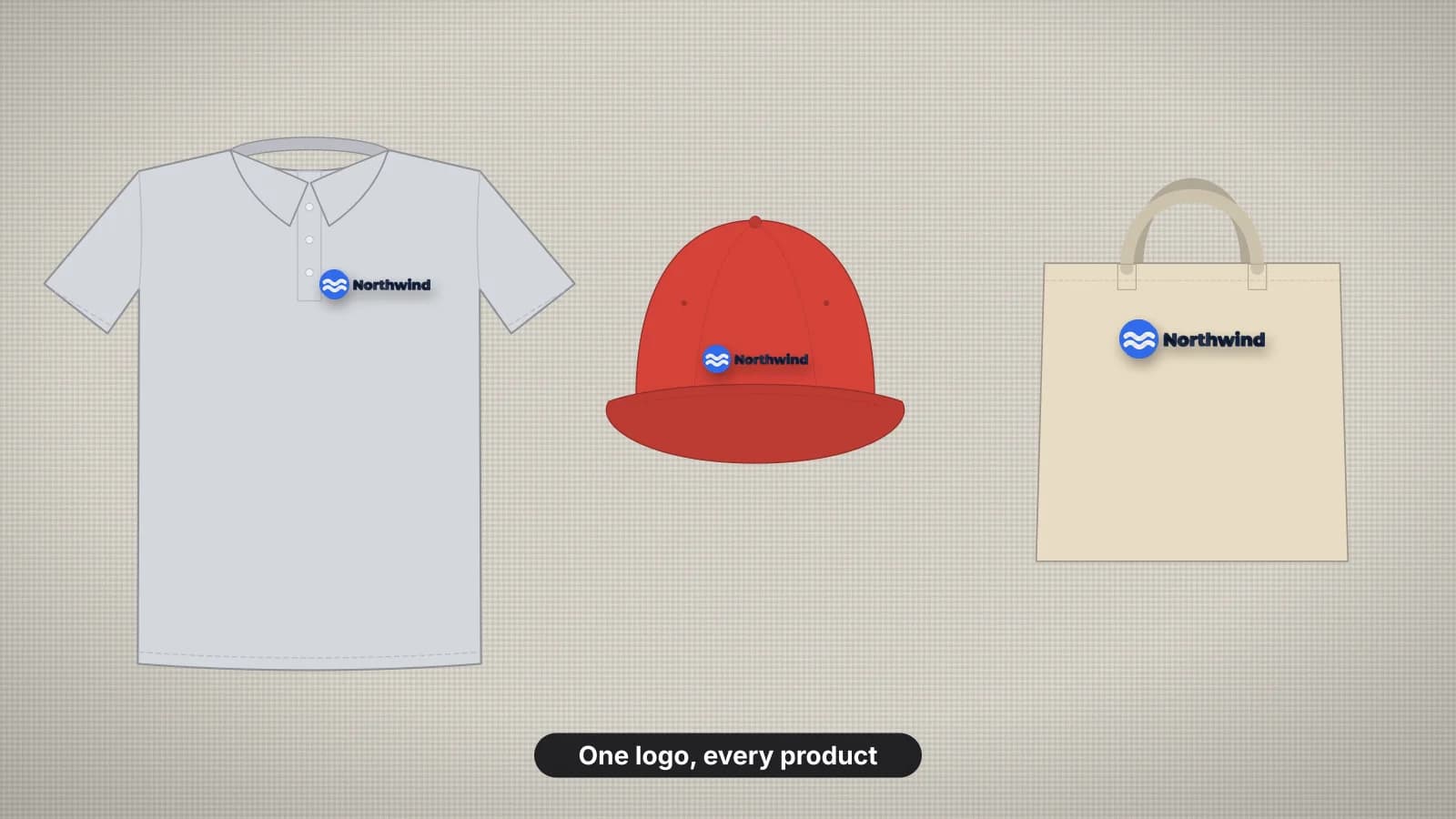
Embroidered polos, caps and totes are some of the most useful merch a small business can have. Staff look like a team, customers carry your name around town, and embroidery holds up well to the weekly washing that work shirts get. The planning is the same whether it's a café ordering a dozen aprons or a contractor kitting out a crew.
This guide covers what to put where and how big, what file the embroiderer needs, whether to stitch in-house or order from a shop, what drives the price and how to get quotes you can compare. If you're the embroiderer quoting the job, the page for embroidery businesses and the quote generator are for you.
Which items, and where the logo goes
| Item | Usual placement | Logo size | Good to know |
|---|---|---|---|
| Polo or work shirt | Left chest | 3–4 in (75–100 mm) wide, up to about 3 in tall | The classic staff shirt; add a name on the right chest |
| T-shirt | Left chest or center chest | 3–4 in, or 4–8 in (100–200 mm) for center chest | Keep designs light on thin jersey |
| Cap | Front | 4–5 in (100–125 mm) wide, up to about 2–2.25 in (50–57 mm) tall | Wide, short logos work best |
| Jacket or fleece | Left chest, sometimes a full back | 3–4 in on the chest; 10–12 in (250–300 mm) on the back | A back design needs a large field |
| Tote bag | Front panel | 5–10 in (125–250 mm) wide | Centered a little above the middle |
| Beanie | Cuff | 2–4 in (50–100 mm) wide, under about 1.75 in (45 mm) tall | Short and bold |
| Sleeve | Upper sleeve | 2.5–3.5 in (65–90 mm) wide | A second logo, a flag or a website |
See it before you order: the embroidery mockup generator puts your logo on a T-shirt, polo, hoodie, cap or tote, digitized and stitched at its real size. The placement guide explains how each position is measured, and the guides to polos, caps and tote bags cover each item.
Getting your logo ready for embroidery
- Send the best file you have. A vector, such as an SVG or the AI, EPS or PDF file your designer made, is ideal; a PNG at least 1,000 px across is fine. Avoid screenshots and logos copied from social media.
- Simplify for thread. Gradients, shadows and fine detail don't stitch. Drop taglines and small print that would come out under about 5 mm tall on a chest logo, or 6–7 mm on a cap.
- Keep the colors few. Two to six thread colors suit most logos; each color is a thread change and can add to the price.
- Plan two versions if your logo is tall: a stacked one for the chest, and a wide, short one for caps.
- Agree on thread colors. Brand colors rarely match a thread exactly, so approve the thread colors on a proof or a sew-out. The thread color matching guide explains how.
The embroidery image checker flags fine detail, too many colors and low resolution, and the logo background remover cuts a logo out of a white background. Only order embroidery of logos you own or have permission to use; the copyright guide explains why.
Try it with your own design
Sign up free, upload an image and get a stitch preview in under a minute.
Drop your image here
PNG, JPG, WebP or SVG · stays on your device
Stitch it in-house, or order from a shop?
| Consider | In-house | Ordering from an embroidery shop |
|---|---|---|
| Upfront cost | A machine, hoops, stabilizer, thread and blanks | Nothing beyond the order |
| Time | Yours: hooping, stitching, trimming and packing | The shop's, with a turnaround to plan around |
| Small and rush orders | One shirt for a new hire, any day | Often an order minimum or a small-order fee |
| Caps and big orders | Much easier on a multi-needle machine with a cap driver | Commercial shops usually run multi-needle machines |
| Best for | Steady small batches, or a business that sells embroidered goods | Occasional orders, large runs, caps and jackets |
Buying a machine only makes sense if you'll keep it busy. The single vs multi-needle guide compares the two kinds, and the business calculator estimates how fast a machine pays for itself. If you stitch in-house, the digitizer turns your logo into a file for your machine: digitizing and previewing are free with an account, and downloads need a plan, from $8 a month billed yearly.
Files: what to send, and what to keep
- Ordering from a shop? Send the artwork. The shop digitizes it for its own machines, often for a one-time digitizing or setup fee, or uses a stitch file you supply.
- Supplying a stitch file? Ask which format the shop wants. Most commercial machines take DST; home machines read their brand's format, such as PES for Brother or JEF for Janome.
- One file per size. A chest logo, a cap logo and a jacket back are separate files. A stitch file only scales by about 10–20% before its density goes wrong, so each size is digitized on its own.
- DST has no colors. Send the thread list or color sheet with it, so the shop threads the right colors.
- Keep everything. Save the stitch files, the thread colors and the approved proof, so reorders match the first order.
To check a stitch file you've been sent, the embroidery file viewer shows its size, colors and stitch count, the sew-out simulator plays it color by color, and embroidery file to image makes a picture of the stitches for a proof. The file formats guide explains each format.
What drives the price
Embroidery prices vary a lot by shop and region, but the same things move them up or down:
| Factor | Why it matters |
|---|---|
| Stitch count | Many shops price stitching per 1,000 stitches with a minimum per piece, so a bigger or denser logo costs more. A typical left chest logo is often around 4,000–6,000 stitches; the stitch count chart gives counts by size |
| Placements | Each position is a separate hooping, and often a separate file |
| Colors | More thread changes; some shops charge for colors beyond a set number |
| Garments | Often the largest part of the price; the brand, fabric and size range all change it |
| Caps, bags and thick items | They take more setup and handling than a flat shirt |
| Digitizing or setup | A one-time fee per new design, often waived on reorders |
| Quantity | The price per piece usually falls as the order grows, through quantity breaks |
| Your own garments | Many shops charge more per piece for customer-supplied items, since a ruined piece can't simply be replaced |
| Turnaround | Rush orders can cost extra |
The pricing guide shows how shops build a price from these, and the embroidery price chart shows example per-piece charges by stitch count and quantity. To estimate stitches before a logo is digitized, use the stitch count calculator.
Quantities, sizes and ordering
- Check the minimum. Many shops set an order minimum, such as 6 or 12 pieces, or add a small-order fee below it.
- Order at a quantity break if you're close to one; the price per piece often drops at points such as 12, 24 or 48 pieces.
- Collect sizes first. Ask staff for their sizes before you order, and add a spare or two for new hires and the occasional bad piece.
- Keep the garment consistent. The same style and color each time means reorders match and the file doesn't need retuning.
- Add names later. Staff names on the right chest personalize uniforms; the names guide covers sizes and fonts.
- Ask for a sample on a large order: one stitched piece shows the size, colors and placement before the full run.
Getting quotes you can compare
- List the items, the quantity of each and the size breakdown.
- Give the placement and logo size for each item, such as a 3.5 in left chest logo on 24 polos and a 4.25 in cap front on 24 caps.
- Send the same artwork to every shop.
- Ask each one for the stitch count per placement, the digitizing or setup fee, the price per piece at your quantity, the garment price, any minimums and the turnaround.
- Ask for a digital proof, and a sew-out sample on larger orders.
- Compare like with like: the same garments, placements and quantities.
Embroiderers can build that quote in minutes with the quote generator: items priced per 1,000 stitches with a minimum, garments with markup, a digitizing fee, discount and tax, printed or saved as a PDF. The pricing calculator works out the rates behind it, and the digitizer gives the exact stitch count and sew time of the customer's logo, so the quote holds.