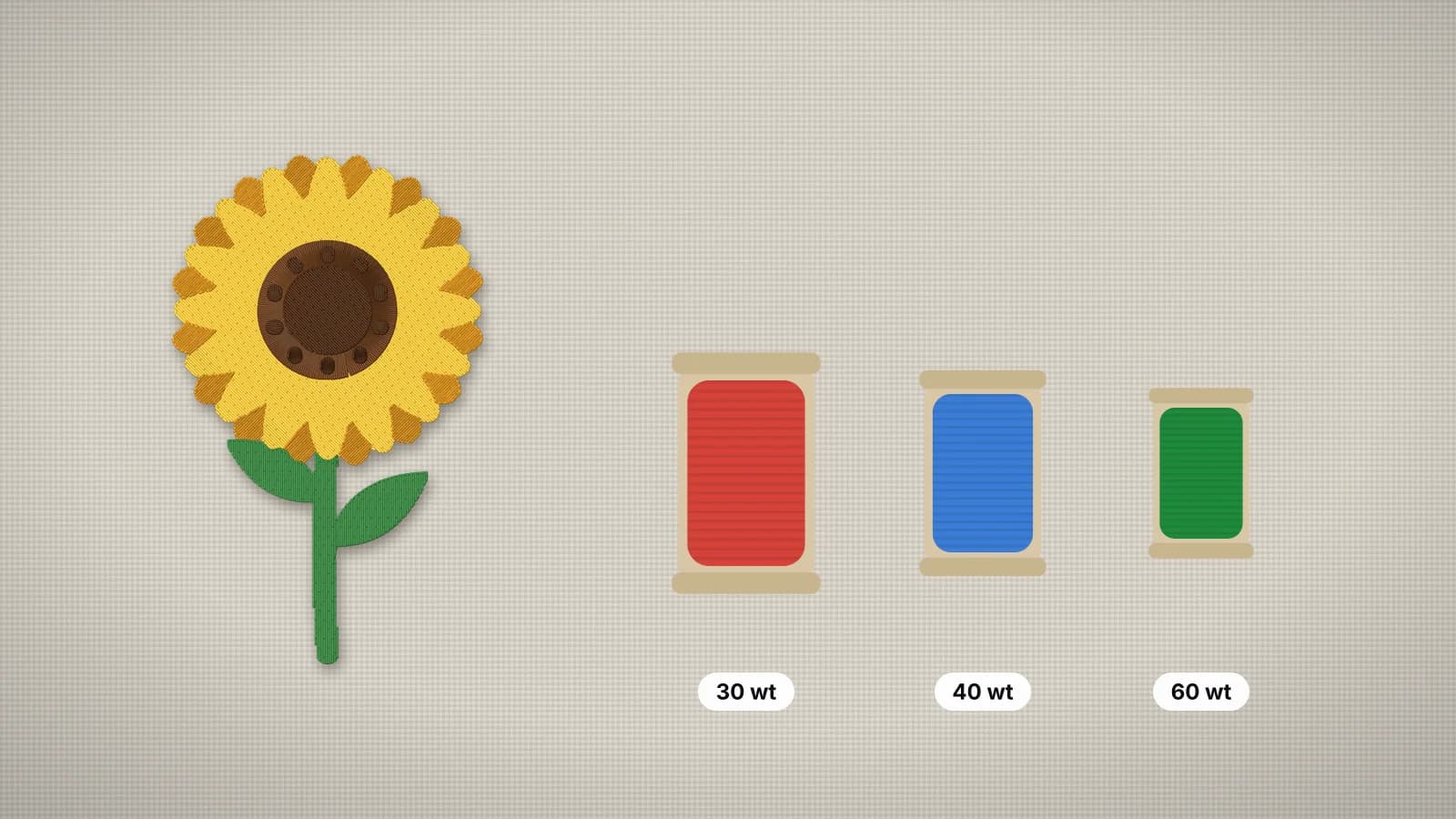
Thread weight is the number on the spool that says how thick the thread is, and it changes more than you might expect: how much a fill covers, how crisp small letters look, which needle you need and whether a file still sews the way it was digitized. Most embroidery uses one weight, 40 wt, but the others have real uses.
This guide goes deeper than the overview in the thread guide: what the numbers mean, 30, 40 and 60 wt compared, when fine thread helps small text, fibers, bobbin thread, and the needle and file changes for each weight.
What the weight number means
- Higher numbers are finer. In the weight system most embroidery threads use, the number is roughly how many kilometers of thread make up a kilogram, so 60 wt is finer than 40 wt, and 30 wt is thicker.
- Some threads use tex or denier instead. Tex is the weight in grams of 1,000 m of thread and denier the weight of 9,000 m, so there a bigger number means a thicker thread, the opposite of wt.
- Ply counts too. A label such as 120d/2 means two strands of 120 denier twisted together.
- Compare within one system. Brands don't all measure the same way, so two 40 wt threads from different makers can differ slightly. Test a new brand before a big job.
The thread weight entry has the short version.
30 vs 40 vs 60 wt at a glance
| Weight | Thickness | Coverage | Best for | Needle, typically |
|---|---|---|---|---|
| 30 wt | Thicker | Covers with fewer stitches | Bold fills, outlines and a hand-stitched look | 90/14, sometimes 80/12 |
| 40 wt | Standard | What most files are digitized for | Almost everything: logos, names, fills and satin | 75/11 |
| 60 wt | Finer | Covers less per stitch | Small lettering, fine detail and delicate fabric | 65/9 or 70/10 |
| Bobbin thread | Finest, often about 60–90 wt | Not on show | Underneath only | Uses the machine's bobbin |
If you only stock one weight, make it 40 wt. Add 60 wt in black, white and a few core colors if you sew small text often, and keep 30 wt for projects that call for it.
Try it with your own design
Sign up free, upload an image and get a stitch preview in under a minute.
Drop your image here
PNG, JPG, WebP or SVG · stays on your device
When 60 wt helps small text
Finer thread makes slimmer stitches, so the gaps inside small letters, such as the holes in a, e and o, stay open where 40 wt would fill them in. It helps most with:
- Lettering close to the minimum size, such as names on cuffs and collars, small taglines and label text.
- Fine detail in a logo: thin lines, small counters and tight curves.
- Light and sheer fabrics, where 40 wt stitching looks heavy.
It's not a cure for text that's simply too small. Below about 4 mm, letters fill in whatever the thread, so make them bigger, use fewer letters or choose a bolder font; see the small text guide.
Sewing a 40 wt file in 60 wt thread keeps small text crisp, but larger fills look thinner and may show the fabric. Test it, or digitize the design with denser fills for 60 wt.
When 30 wt makes sense
- Bold coverage with fewer stitches. Each stitch covers more, so a fill can be digitized with wider spacing and sews in less time.
- A hand-stitched look for outlines, bean stitch and redwork-style designs on quilts and linens.
- Heavy fabrics such as canvas, denim and towels, where finer thread can look thin.
- Not for small text. Thick thread fills in counters quickly, so keep lettering large.
Sewn on a file made for 40 wt, 30 wt thread packs too much into each area: it can sew stiff, break thread and needles, and pucker. Use a file digitized for it, with lighter density. A 90/14 needle is typical, and some embroiderers loosen the top tension slightly for heavier thread.
Polyester, rayon and cotton by weight
| Fiber | Strength and washing | In fine weights | In heavy weights |
|---|---|---|---|
| Polyester | Strong and colorfast; stands up to hot washes and bleach-based detergents | A good choice for 60 wt small text on items washed often | Bold and durable on workwear and towels |
| Rayon | The highest sheen; slightly weaker and can fade with bleach | Can be more fragile; slow the machine if it breaks | A rich sheen on decorative pieces |
| Cotton | Matte, with more lint; weaker than polyester | Suits heirloom and quilting detail | A natural, hand-embroidered look |
Availability varies: not every color comes in every weight, so check the thread line before you plan a design around 60 wt or 30 wt. Metallic thread has its own rules; see the metallic thread guide.
Bobbin thread weight
- Finer than the top thread, often around 60–90 wt, so more fits on a bobbin and the back stays flat. Many embroiderers use the same bobbin thread under 30, 40 and 60 wt tops.
- Polyester or poly-cotton bobbin thread is common, prewound or wound from a cone. Check the bobbin size your machine takes.
- White under light fabric, black under dark, so it doesn't peek out at the edges of satin columns.
- Match the top thread where the back shows, as on towels, lace and ornaments, by winding the bobbin from the top thread or using a matching color.
- Check the balance after changing weights. On the back of a satin column, about the middle third should show bobbin thread; adjust the top tension in small steps if it doesn't.
The bobbin thread entry covers types, and the thread tension entry explains the balance.
Practice on a free design
114 ready-to-sew designs in every machine format, free with an account.

Needles and file changes for each weight
| Thread | Needle | File changes |
|---|---|---|
| 30 wt | 90/14, or 80/12 on lighter fabric | Lighter density, wider fill spacing and fewer layers |
| 40 wt | 75/11; 80/12 on heavy fabric | None: most files are made for it |
| 60 wt | 65/9 or 70/10 | Denser fills for full coverage; small text often sews as is |
| Metallic | A metallic or topstitch needle, often 80/12 or 90/14 | Lighter density and longer stitches |
Too small a needle for the thread is a classic cause of shredding, and too large a needle leaves visible holes round small details; the needle guide covers sizes. In the digitizer, the default fill spacing of about 0.4 mm is a typical setting for 40 wt, and you can change the fill density for a heavier or finer thread. Digitizing and previewing are free with an account, and the density guide explains spacing.