 Free previewAppliqué makerShapes, Greek and varsity letters or a silhouette as appliqué: placement line, tack-down and satin border, plus a cutting template.Open the tool
Chenille is the fuzzy, towel-like texture on varsity letters, letterman jackets and retro patches. It looks like embroidery, but it's made on a different kind of machine, with yarn instead of thread, and most embroiderers never sew it themselves.
This guide explains how chenille is made, which machines can make it and what letters, patches and machines cost. Then it covers what you can do on a home or small-shop machine: appliqué varsity letters, faux chenille textures, and ordering real chenille patches when only the real thing will do.
What is chenille embroidery?
Chenille embroidery is yarn looped up through a base fabric, usually felt, to make a soft pile that stands above the surface. The word is French for caterpillar, after the fuzzy look. It uses two stitches, both made by the same hooked needle:
- Moss stitch, also called loop stitch: rows of open loops that form the plush, terry-like fill of a letter or mascot. The higher the needle is set, the taller and fuzzier the loops.
- Chain stitch: the same loops pulled through each other into a flat chain, used for outlines, script lettering and small details. Chain stitch is also a style of its own, seen on vintage bowling shirts and workwear.
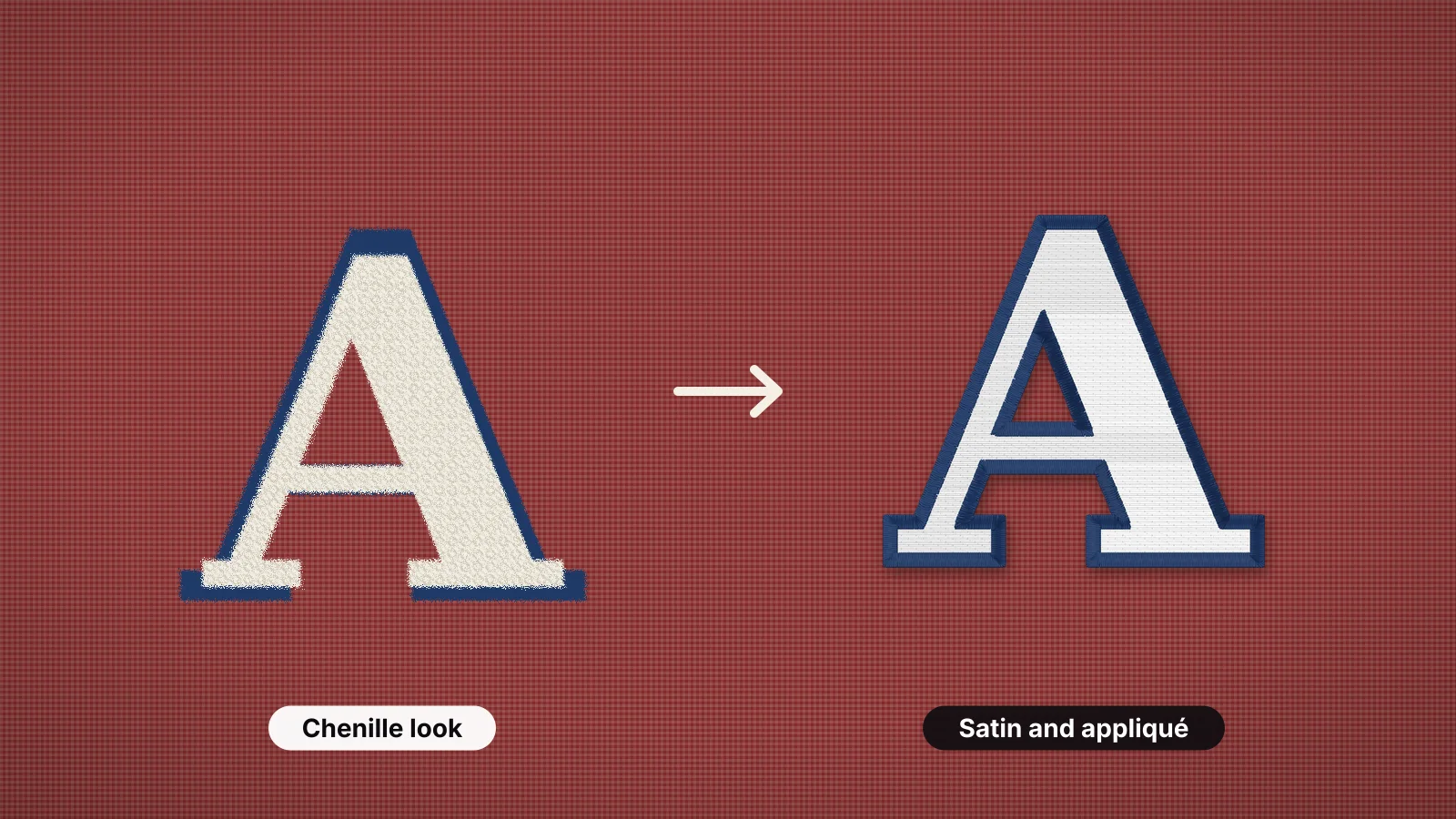
The yarn is much thicker than embroidery thread, typically acrylic or wool, and the base is a firm felt that carries the weight of the loops. Most varsity letters also have a second, larger felt layer behind the chenille, so a border of contrasting felt shows round the edge. The chenille glossary entry has the short version.
| Chenille | Flat embroidery | Appliqué with a satin border | |
|---|---|---|---|
| Made with | Yarn, a hooked needle and a looper, with no bobbin | 40-weight thread, a needle with an eye and a bobbin | A fabric piece held down by satin stitches |
| Texture | Raised, fuzzy loops | Flat with a smooth sheen | Flat fabric framed by a raised satin edge |
| Machine | A chenille machine or chenille head | Any embroidery machine | Any embroidery machine |
| Detail | Bold shapes only | Fine detail and small text | Bold letters and large shapes |
| Typical use | Varsity letters, retro patches | Logos, names, detailed badges | Varsity and Greek letters, big motifs |
How are chenille patches and varsity letters made?
A chenille letter is stitched on felt by a chenille machine, cut out, layered on a second felt piece and given a backing. Patch makers follow roughly the same four steps:
- Digitize for chenille. The design is planned in professional software with chenille tools, such as Tajima DG/ML by Pulse or the chenille element of Wilcom EmbroideryStudio, an extra-cost add-on. The file sets moss areas, chain outlines and the needle height for each part.
- Stitch the chenille on felt. The yarn feeds from below the fabric, and the hooked needle pulls each loop up through it, so there's no bobbin thread. Moss fills the shape and chain stitch outlines it. Some machines pair chenille heads with ordinary embroidery heads, so flat-stitched details sew in the same run.
- Cut out and layer. The stitched felt is cut round the design, then stitched or glued onto a larger felt piece in another color, which is cut to leave an even border. Some patches use an embroidered or merrowed edge instead.
- Add a backing. Letters for jackets are usually sewn on. Patches can also have a heat-seal (iron-on), hook-and-loop or adhesive backing.
Schools set their own rules, but varsity letters commonly run 4–8 in (100–200 mm) tall, often 6–8 in for a full varsity letter, worn on the left chest of a letterman jacket. Bars, pins and years for each season are added on or around the letter.
Try it with your own design
Sign up free, upload an image and get a stitch preview in under a minute.
Drop your image here
PNG, JPG, SVG, PDF or AI · stays on your device
Not sure what to expect? See real examples or how it works.
Which machines can make chenille?
Only machines with chenille heads can make true chenille, and these are industrial machines built for patch makers and letter suppliers. A regular embroidery machine can't, whether it's a home single-needle or a 15-needle commercial head, because its heads are built for thread: a needle with an eye carries the top thread down to meet a bobbin thread. A classic chenille head uses a hooked needle and a looper to loop thick yarn up from below, and Tajima also makes special lock-stitch chenille heads.
| Machine | How it stitches | Makes chenille? |
|---|---|---|
| Home embroidery machines from Brother, Janome, Bernina, Singer and others | Single-needle lockstitch with a bobbin | No; appliqué and faux textures only |
| Commercial multi-needle machines such as Ricoma, Brother PR, Melco and standard Tajima heads | Multi-needle lockstitch | No, unless the machine has chenille heads |
| Tajima TCMX series | Chenille heads that sew loop (moss) and chain stitch, from a single head up to multi-head models | Yes |
| Tajima TCMX Mixed Type | Chenille heads paired with standard embroidery heads | Yes, plus flat embroidery in the same run |
| Tajima TLMX series | Lock-stitch chenille heads, on their own or paired with standard embroidery heads | Yes |
Tajima introduced its first electronic chenille machine, the TMCE series, in 1982, and Barudan and Melco have also made chenille machines. Chenille files are their own kind of file too: they carry moss, chain and needle-height commands that a home machine can't use, and a PES or JEF file can't make a chenille head loop yarn.
A design file for a home machine sold as chenille isn't true chenille. Read the description: it's usually appliqué, a fringe design or a terry-fabric fill. These can look great, but they won't have the dense yarn pile of a real varsity letter.
How much does chenille cost?
Chenille is cheap to buy and expensive to make yourself, because the machines are industrial. Typical figures in late 2026:
| What | Typical price, about | Notes |
|---|---|---|
| A stock chenille letter, 4–8 in | $10–$25 each | Sold by school letter suppliers and craft retailers; small iron-on letters cost less |
| Custom chenille patches | $3–$10 each at 25–100 pieces; more for large or double-felt patches | Minimums of about 10–100 pieces are common, and many makers price by (width + height) ÷ 2 |
| Production time | About 1–4 weeks, plus shipping | Varies by maker and order size; rush service costs extra |
| A used multi-head chenille machine | Asking prices of roughly $15,000–$25,000 in used-machinery listings | Depends on heads, age and condition; new machines are quoted by dealers |
For a club, a school or a small brand, ordering from a patch maker is almost always cheaper than buying a chenille machine, and it gets you the dense, even pile that only a chenille head makes. If you sell varsity-style gear from a home machine, appliqué is the practical route, and the next two sections cover it.
How do you get the varsity letter look on a home machine?
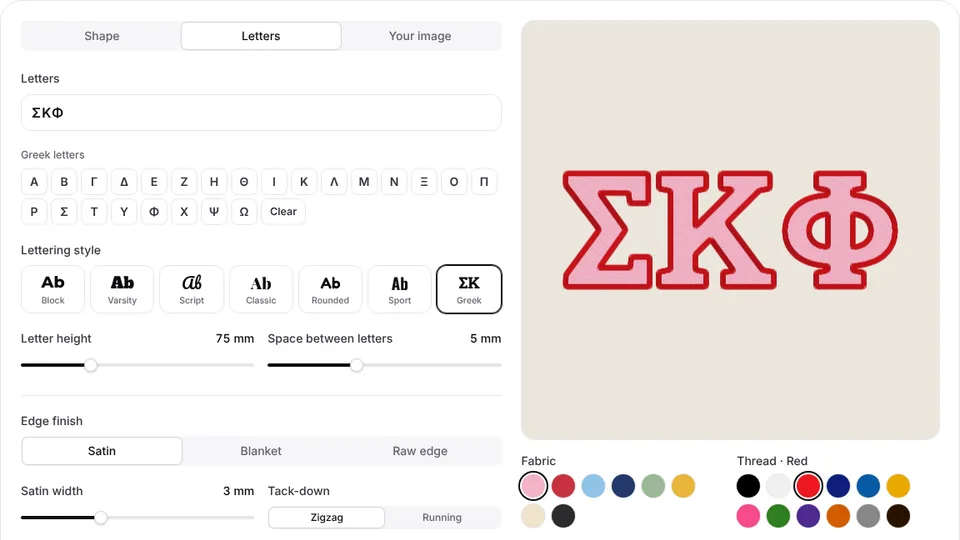
Appliqué gets closest: a felt or twill letter stitched down with a satin border, often on a second layer of fabric for the two-tone varsity edge. It's how most varsity and Greek letter sweatshirts are made, and any embroidery machine can sew it. The appliqué maker builds the file from typed letters in a varsity, block or sport style, with a placement line, tack-down and satin border, plus a cutting template at full size.
- Pick the letters and size. Type up to eight characters, choose the varsity style and set the letter height, from 25 to 200 mm. A single varsity initial on a chest is usually about 100–150 mm (4–6 in) tall; a 5 × 7 in hoop takes a letter up to about 4–5 in, and larger letters need a bigger hoop.
- Set the satin width. About 2.5–4 mm covers the cut edge of felt or twill, and the tool goes from 2 to 5 mm. Wider borders need a heavier stabilizer.
- Cut the letter. Download the cutting template as an SVG for a Cricut or Silhouette, or print it and cut by hand. Or lay a piece of felt over the placement line and trim close to the tack-down in the hoop.
- Sew the three stops. The machine stitches the placement line, stops while you lay the fabric, stitches the tack-down, stops while you trim, then sews the satin border. Use cut-away under sweatshirts and knits.
- Add the border layer. For the two-tone look, fuse or stitch a larger backing letter in the border color first, cut about 3–6 mm bigger all round, then sew the main letter on top.
How to make appliqué letters covers fonts, layering and placement in detail, and the appliqué guide covers fabrics and trimming. Tackle twill gives the athletic look; wool-blend felt gives the softer, matte look closest to a real varsity letter.
What are the faux chenille options?
Three techniques add the fuzzy texture that plain appliqué lacks. None is true chenille, but each works on an ordinary machine:
| Technique | How it works | Best for |
|---|---|---|
| Fuzzy-fabric appliqué | Appliqué a letter cut from terry towel, minky or another plush fabric, inside a dense satin border that holds the pile at the edges | Varsity-style letters with a soft feel, kids' clothes |
| Slash-and-fluff | Stack 4–6 layers of loose-weave cotton, sew parallel lines about 1/2 in (12 mm) apart on the bias, cut all but the bottom layer between the lines, then wash and dry so the cut edges bloom | Blankets, quilt blocks, bags and big letters; it also works on a sewing machine |
| Fringe designs | A design digitized for the method: you cut the bobbin threads on the back and brush up the top threads into a fuzzy fringe | Fuzzy letters, manes and accents, from designs made for it |
Test any faux chenille on the real fabric and wash it once before you sell it. Slash-and-fluff needs fabric that frays, so mostly cotton or linen; polyester barely blooms. Terry appliqué needs a topping so the satin border sits on the pile instead of sinking into it.
How do you order chenille patches?
Patch makers quote from your artwork, size, colors, border and backing, so have these ready before you ask:
- Artwork as a vector file (SVG, AI or PDF) or a clean PNG. Bold shapes work best; chenille can't hold thin lines or small text, so makers add those in flat embroidery or chain stitch.
- Size. Many makers price by (width + height) ÷ 2, so a 4 × 6 in patch prices as a 5 in patch. Varsity letters are usually ordered by height.
- Colors for the yarn, the felt and the border. Makers have set yarn and felt color cards, so choose from those rather than asking for an exact ink color.
- Border: single felt, double felt, or an embroidered or merrowed edge.
- Backing: sew-on, iron-on (heat seal), hook-and-loop or adhesive. Sew-on lasts longest on a jacket.
- Quantity and deadline. Minimums of 10–100 pieces are common and production takes about one to four weeks, so order well before a season starts or an event.
Ask for a digital proof and, on a big order, a sample. If you're making gear for a school or team, use the mascot and lettering only with their permission; embroidery design copyright explains the basics. For flat stitched patches you can make on your own machine, see how to make embroidered patches.
Practice on a free design
167 ready-to-sew designs in every machine format, free with an account.
What Embrizo can and can't do for chenille-style projects
Embrizo makes lockstitch files for home and commercial embroidery machines, so it doesn't make chenille files. What it makes covers the rest of a varsity-style project:
- Appliqué varsity and Greek letters with the appliqué maker: placement line, tack-down and satin border as three color stops, a cutting template, and files in PES, DST, JEF, EXP, VP3, XXX and more.
- Flat embroidered patches with the patch designer: a circle, oval, shield or rectangle with a border and arched text, sent straight to the digitizer.
- Mascots, crests and years from your artwork with the digitizer: upload a PNG, JPG, SVG or PDF and it picks satin, fill and running stitch for each shape, with a stitch preview before you sew.
- Names and numbers for a whole team with batch name embroidery, in one font and height.
Designing, digitizing and previewing are free with an account; downloading the machine files needs a plan. For true chenille, order from a patch maker and use Embrizo for the flat-stitched and appliqué parts of the garment.