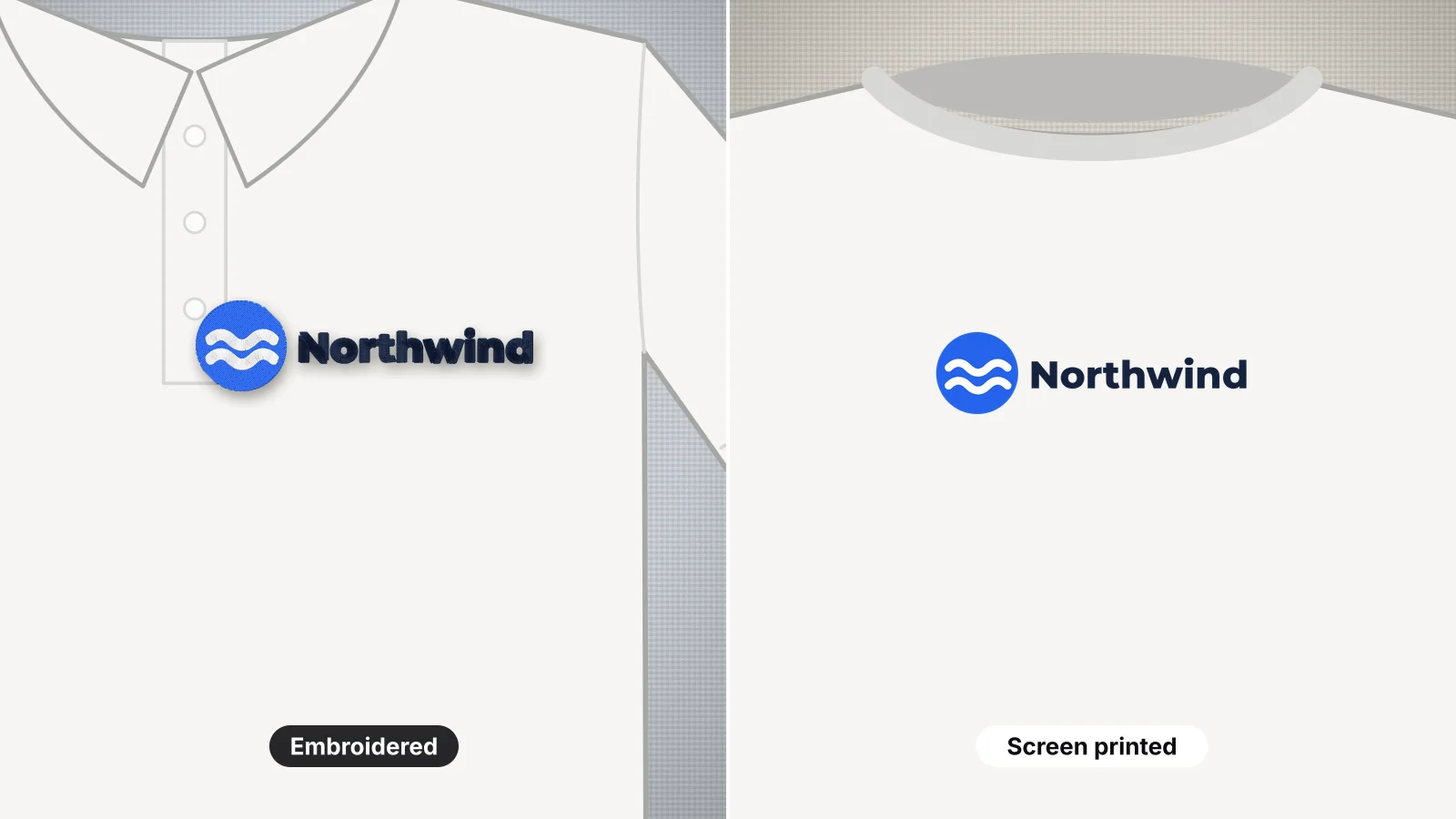
Ordering branded shirts and caps, or adding merch to your shop, usually comes down to two choices: stitch the logo or print it. Every kind of business uses both, and neither is better in general. They look different, last differently, and their costs behave differently as the quantity changes.
This guide compares them on the points that matter when you're paying for or selling the result: look, durability, setup, cost per piece at different quantities and which garments suit each. If you're leaning toward embroidery, the embroidery pricing calculator estimates a price per piece from the stitch count.
Embroidery vs screen printing at a glance
| Factor | Embroidery | Screen printing |
|---|---|---|
| Look | Raised, textured thread with a sheen; reads as premium | Flat ink on the surface; smooth or soft to the touch |
| Detail | Bold shapes and lettering from about 5 mm tall; no gradients | Fine lines, small text and halftone shading |
| Colors | Each color is a thread; extra colors add little cost on a multi-needle machine | Each color needs its own screen, so colors add setup cost |
| Setup | Digitizing the logo once, reused for reorders | A screen for each color in each design |
| Price driven by | Stitch count, mostly set by the design's size | Number of colors and print locations, and the quantity |
| Durability | Usually outlasts the garment | Lasts many washes when well cured; can crack or fade over time |
| Best on | Polos, caps, jackets, fleece, beanies, bags and workwear | T-shirts, tank tops, large back prints and thin performance tees |
| Typical size | Left chest logos and small to medium designs | Anything up to a full front or full back |
Look and feel
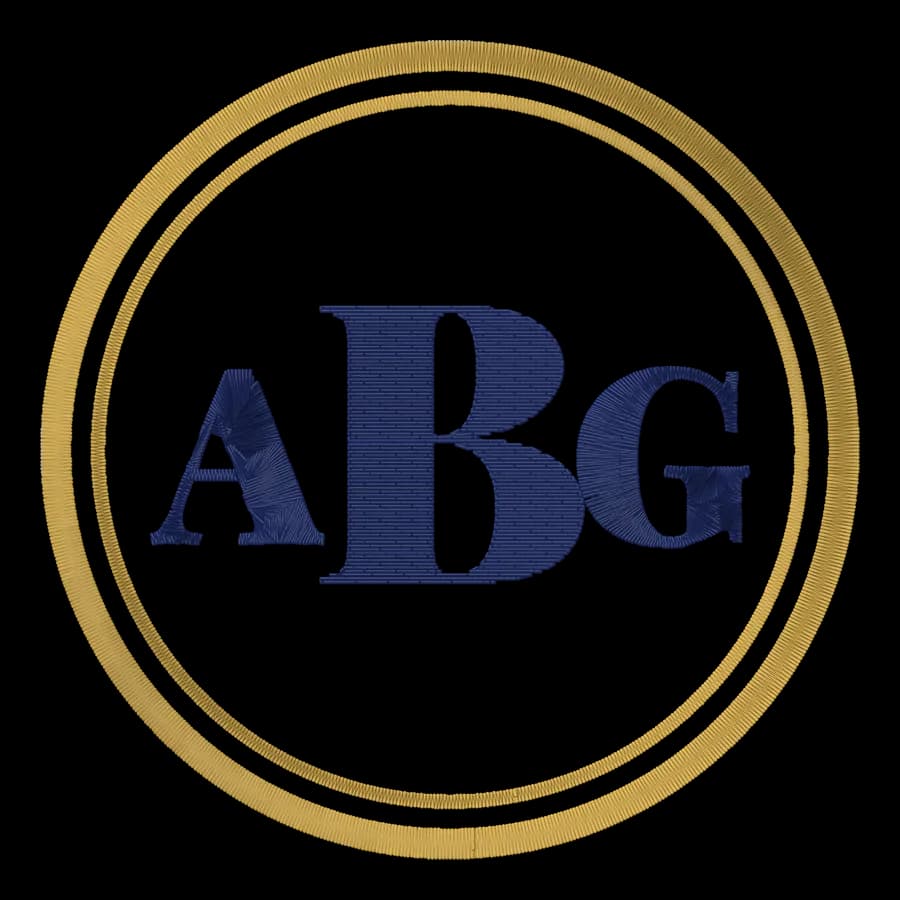
Embroidery has texture and depth. Satin lettering catches the light, fills have a woven pattern and the logo stands slightly off the fabric. That's why it's the default for uniforms, polos, caps and corporate gifts: it looks made to last. It suits bold logos with a few solid colors, and it can't reproduce gradients or photographic shading, because thread is simplified into flat colors.
Screen printing lays ink on the surface. It carries fine lines, small text and shading with halftones, and it covers large areas without adding weight. A big full front design that would be a heavy, stiff patch in thread stays light and flexible in ink. Soft, water-based inks are barely felt; thicker inks sit on top of the fabric.
Small text is often the deciding factor. A tagline that reads fine in print can be too small to stitch: keep embroidered letters at least about 5 mm (0.2 in) tall in a bold font. The lettering size calculator checks it for a given width.
Try it with your own design
Sign up free, upload an image and get a stitch preview in under a minute.
Drop your image here
PNG, JPG, WebP or SVG · stays on your device
Durability and washing
- Embroidery is thread stitched through the fabric, so it doesn't crack or peel. With polyester thread and the right backing, it usually looks good for as long as the garment lasts. What spoils it is puckering from the wrong backing, or snags on long satin stitches.
- Screen prints last many washes when the ink is properly cured. Over time, prints can fade, and thick ink can crack, especially on stretchy fabric. Washing inside out in cool water and skipping high dryer heat helps both.
- Hard-wearing items such as workwear, chef coats, team jackets and caps tend to favor embroidery, and it's the usual choice for structured cap fronts.
Setup and cost per piece by quantity
The two methods spread their costs differently. Screen printing has a fixed setup for each color: a screen has to be made and the press set up whether you print a dozen shirts or several hundred, so the price per piece falls steeply as the quantity grows. Embroidery's setup is digitizing the logo, usually charged once per design and reused for reorders. After that, each piece takes machine time set mainly by the stitch count, so the price per piece falls more gently.
| Order | Embroidery | Screen printing |
|---|---|---|
| A few pieces | Often practical: one setup fee, then a per-piece price, usually with a minimum per piece | Often expensive per piece, and many printers set a minimum order |
| Dozens | Competitive for left chest logos and caps | Competitive for one- and two-color designs |
| Around a hundred | The price eases with quantity breaks | Usually cheaper per piece, especially for large designs |
| Hundreds or more | Limited by machine time; multi-head machines help | Usually the lowest cost per piece for T-shirts |
Prices vary by shop and region, so compare quotes for the same quantity, sizes and locations. For embroidery, ask for the stitch count or estimate it with the stitch count calculator: a small left chest logo costs far less to sew than a full back. If you sell embroidery, the pricing calculator and the quote generator turn stitch counts into prices, and the pricing guide explains rates per 1,000 stitches and quantity breaks.
Which garments and items suit each
| Item | Usually better | Why |
|---|---|---|
| Polo shirts | Embroidery | A stitched left chest logo is the classic polo look, and piqué suits thread |
| Structured caps | Embroidery | Stitches hold up on the stiff, curved front and give the raised look people expect |
| Jackets, fleece and hoodies | Embroidery for chest logos; either for big back designs | Thick fabric carries stitches well, but large back designs get heavy in thread |
| T-shirts | Screen printing for large designs; embroidery for small chest logos | Thin jersey puckers under dense stitching |
| Thin performance and stretch wear | Screen printing | Ink stays light and flexible; embroidery needs a light, open design |
| Beanies and towels | Embroidery | Rib knit and terry pile are hard to print evenly |
| Tote bags | Either | Canvas prints well and also takes dense embroidery |
The embroidery size chart gives standard sizes for each placement, and the mockup generator shows a logo stitched on a T-shirt, polo, hoodie, cap or tote at its real size before you order.
When to choose each
Choose embroidery when:
- The logo is small to medium and bold, such as a left chest, cap front or sleeve.
- You want a premium, lasting look for staff uniforms, client gifts or retail merch.
- The item is heavy or textured: polos, fleece, jackets, caps, beanies, bags and towels.
- Quantities are small, or reorders come in batches; the digitized file is reused each time.
Choose screen printing when:
- The design is large, detailed or shaded.
- You're ordering a lot of T-shirts for an event, a team or a giveaway.
- The fabric is thin or stretchy and needs to stay light.
Many businesses mix them: embroidered polos and caps for staff, printed tees for events. One garment can carry both, with a small stitched logo on the chest and a large print on the back. For small runs of full-color artwork, print shops also offer digital methods such as DTF and DTG, which skip screens.
Getting a logo ready for embroidery
A logo made for print usually needs a few changes before it stitches well: fewer colors, bolder lines, no gradients and a tagline big enough to read. Then it has to be digitized, turned into a stitch file for the machine.
- Check the artwork with the embroidery image checker, which flags fine detail, too many colors and low resolution.
- Simplify it: merge shades, drop or enlarge small print and remove the background. The artwork guide covers each fix.
- Digitize it at the size you'll sew. In the digitizer, create a free account, upload the logo, set the width and fabric and check the stitch preview.
- Download the format the machine reads, often DST for commercial machines, with a plan from $8 a month billed yearly.
Print shops adding embroidery to their services can find the workflow on the page for print shops.