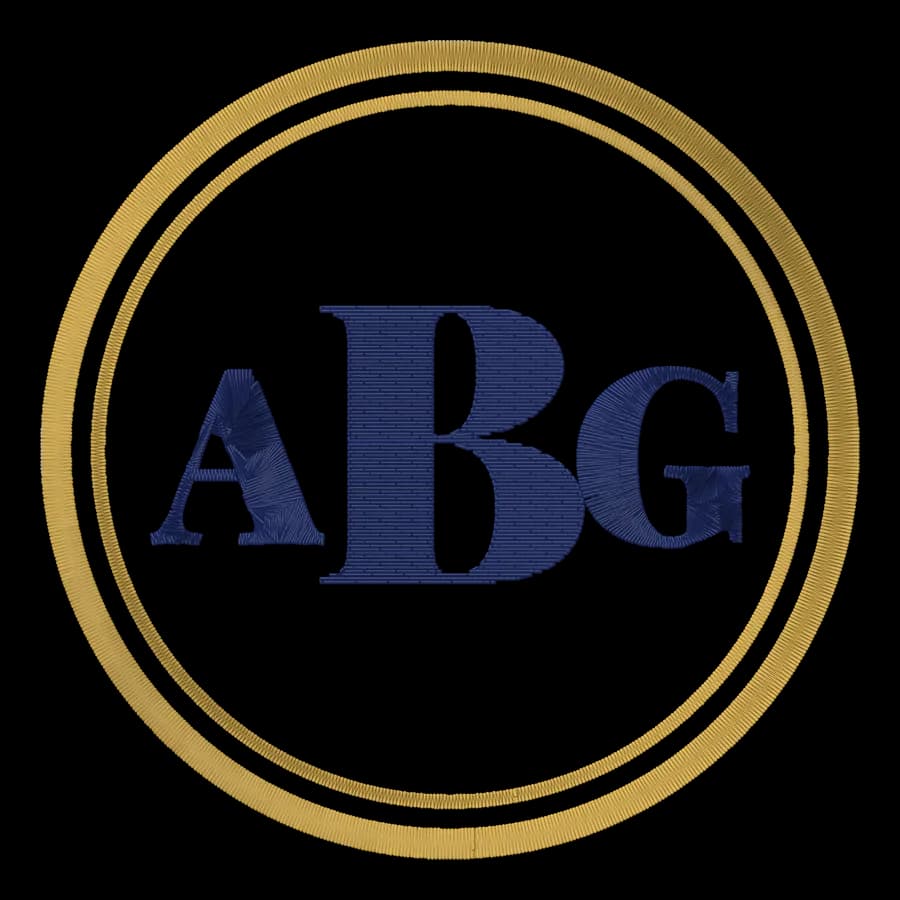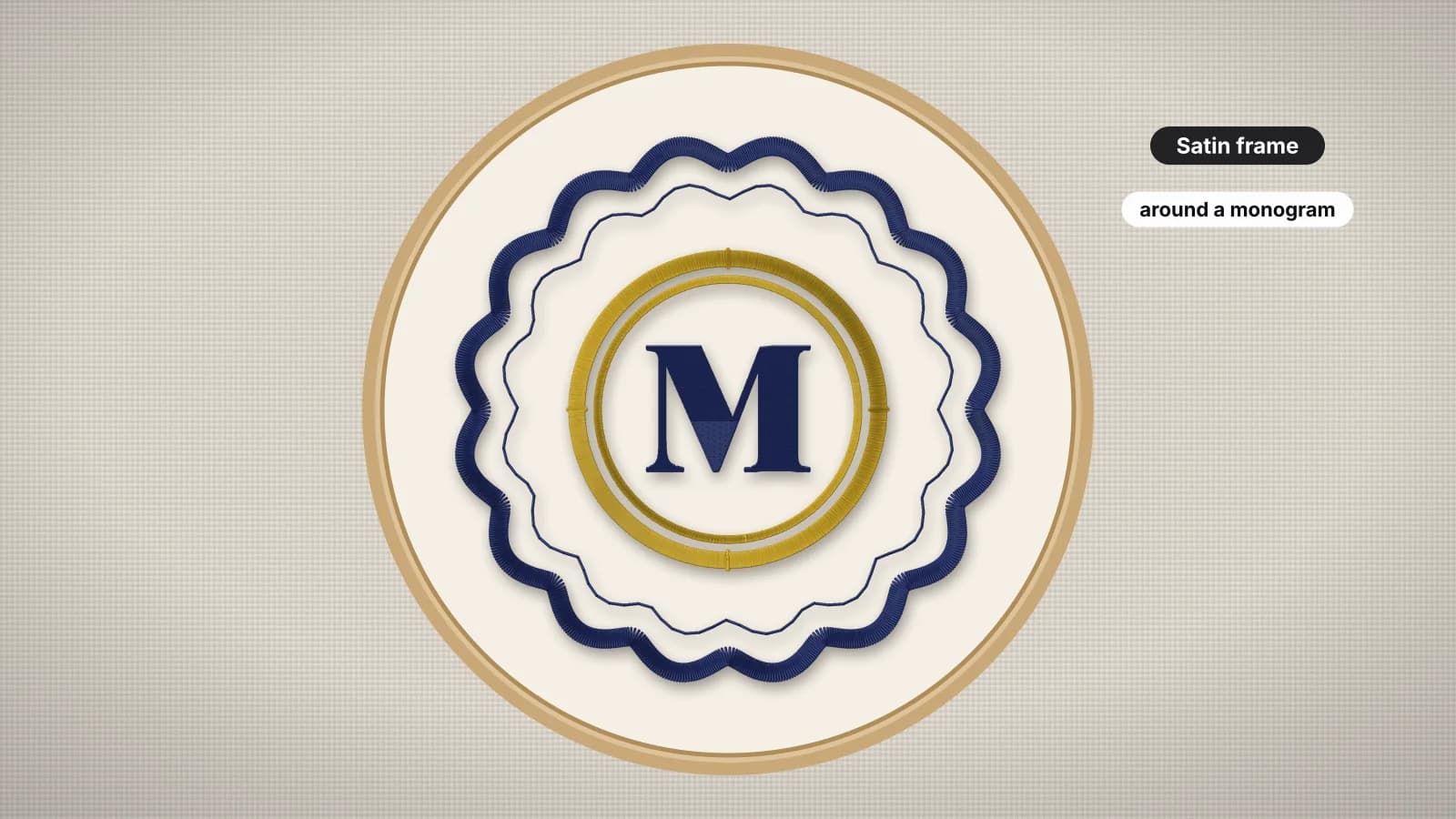
A frame turns a plain monogram or name into a finished design: a circle round a single initial on a pillow, an oval round a couple's names on a wedding gift, a rectangle round a quilt label. It's only a line of stitches, but its stitch type, its width and the gap it leaves decide whether the design looks crisp or crowded.
This guide compares running, bean and satin borders, frame shapes, sizing, stitch order and borders on different fabrics. The monogram guide covers the letters inside, and the frame maker makes borders on their own or round a design; saving the file needs a paid plan.
Running, bean and satin borders
| Border | What it looks like | Typical width | Best for | Watch for |
|---|---|---|---|---|
| Running stitch | A single fine line | One thread | Delicate frames, quilt labels and light fabrics | Disappears on towels and textured knits |
| Bean stitch | A bold, hand-drawn line; each stitch sewn three times | About 1 mm | Vintage and redwork styles, quilts and kids' items | Many needle holes in one place on fine fabric |
| Satin border | A smooth, solid band | Often about 2–4 mm | Classic monogram circles, patches and towels | Pulls the fabric in; wider than about 7 mm lies loose |
| Double frame | A thin line inside a satin band, or two fine lines | Combined | Formal monograms and wedding linens | Needs extra room and adds width |
A running stitch border is the lightest and quickest. A bean stitch border follows the same path sewn forward, back and forward again, so it reads like a hand-drawn line and holds up better on texture. A satin stitch border is the boldest.
Frame shapes and what they suit
| Shape | Suits | Tip |
|---|---|---|
| Circle | Single initials and three-letter monograms | The classic monogram frame; center the monogram by eye, not just by its outline box |
| Oval | Names, couples' names and wide monograms | Follows a wide design without big empty spaces above and below |
| Square or rectangle | Labels, quilt labels and blocks of text | Round the corners slightly so satin doesn't pile up at the points |
| Scalloped or wavy | Baby items, kitchen linens and vintage styles | Looks best fairly large, about 70 mm and up; tiny satin scallops blur together |
| Heart | Valentine's, wedding and baby gifts | Also best at about 70 mm and up, so the point and the dip sew cleanly |
| Shield or crest | Clubs, teams and school designs | Pairs well with a block or varsity font |
Try it with your own design
Sign up free, upload an image and get a stitch preview in under a minute.
Drop your image here
PNG, JPG, WebP or SVG · stays on your device
Sizing the frame to the design
Work outwards from the design. The frame's size is the design, plus a gap on each side, plus the border's own width on each side:
- Gap: leave about 5–10 mm between the design and the inside of the frame, toward the top of that range on towels and fleece, where stitches spread.
- Border width: a satin border of about 2–4 mm suits most monograms of about 2–3 in (50–75 mm). Go wider on big pieces and thinner on small ones.
- A worked example: a name 80 mm wide and 20 mm tall, with a 5 mm gap and a 3 mm satin border, makes a frame 80 + 10 + 6 = 96 mm wide and 20 + 10 + 6 = 36 mm tall. That's just too wide for the 94 mm a 4×4 in hoop takes with a margin, so it needs a 5×7 in hoop or a slightly narrower name.
- Balance the weight. A frame much bolder than the letters overpowers them, and one much thinner looks unfinished. Match a satin border roughly to the letters' stroke width.
In a circle, the corners of the letters come closest to the frame. A monogram about as tall as it is wide needs a circle about 1.4 times its width before you add the gap.
Stitch order
- Center first, frame last. Many digitizers sew from the center outwards: the monogram or name first, then the frame. The fabric pulls in slightly as the center sews, and a frame sewn after it lands where the fabric has settled.
- Inner lines before outer ones. In a double frame, sew the thin inner line first and the satin band last, so the satin covers any small misalignment at its edge.
- One trim between the parts. The move from the design to the frame is one jump, and most machines trim it automatically.
- Hide the join. A closed frame starts and ends at the same point; many digitizers put that point at the bottom, where a small join is hardest to see.
- Same color, no stop. If the frame uses the same thread as the letters, sew it straight after them so there's no color change.
The sewing order entry explains why order matters, and registration covers outlines that miss what they surround.
Borders on towels, knits and quilts
| Fabric | Border that works | Why |
|---|---|---|
| Towels and fleece | Satin, or bean stitch with a topping | A single running stitch sinks into pile and disappears |
| T-shirts and knits | Satin or bean stitch, over cut-away backing | Knits pull in, so a circle can sew slightly oval without enough pull compensation |
| Quilting cotton and linen | Running or bean stitch | Light borders keep blocks and labels soft |
| Patches | A satin edge, sewn last | The satin border is the finished edge of the patch |
| Caps and thick fabric | Satin, kept narrow | Wide satin on a curved front distorts |
See how to embroider towels, the quilt label guide and the patches guide for those items. On knits, pull compensation helps keep a circle round.
Matching the frame to the lettering
- Classic serif monograms: a thin running or double frame, or a narrow satin circle.
- Block initials: a bold satin circle or square, about as heavy as the letter strokes.
- Script names: an oval or a scalloped frame, with plenty of room at the ends for the swashes.
- Kids' names: a bean-stitch frame in a contrasting color, or a rounded rectangle.
- Color: the same thread as the letters looks elegant and saves a stop; a contrasting color makes the frame part of the design.
The best fonts guide pairs fonts with uses, and the monogram maker sets classic one- and three-letter monograms.
Practice on a free design
114 ready-to-sew designs in every machine format, free with an account.




Making a framed design
- A frame on its own or round a stitch file: the frame maker makes circle, oval, square, scalloped and heart borders in satin or triple run, and can center a design inside so it sews first and the frame last. Saving the file needs a paid plan.
- A name or monogram to frame: make it first with text to embroidery or the monogram maker; the combining guide covers gaps and order when you put files together.
- A custom frame in your artwork: draw it as part of the design and upload it to the digitizer. Lines thinner than about 0.75 mm sew as running or bean stitch and wider ones as satin, and you can override a color's stitch type. Digitizing and previewing are free with an account.
Check the preview for an even gap between the design and the frame, then test-sew on a scrap of the same fabric before the real piece.