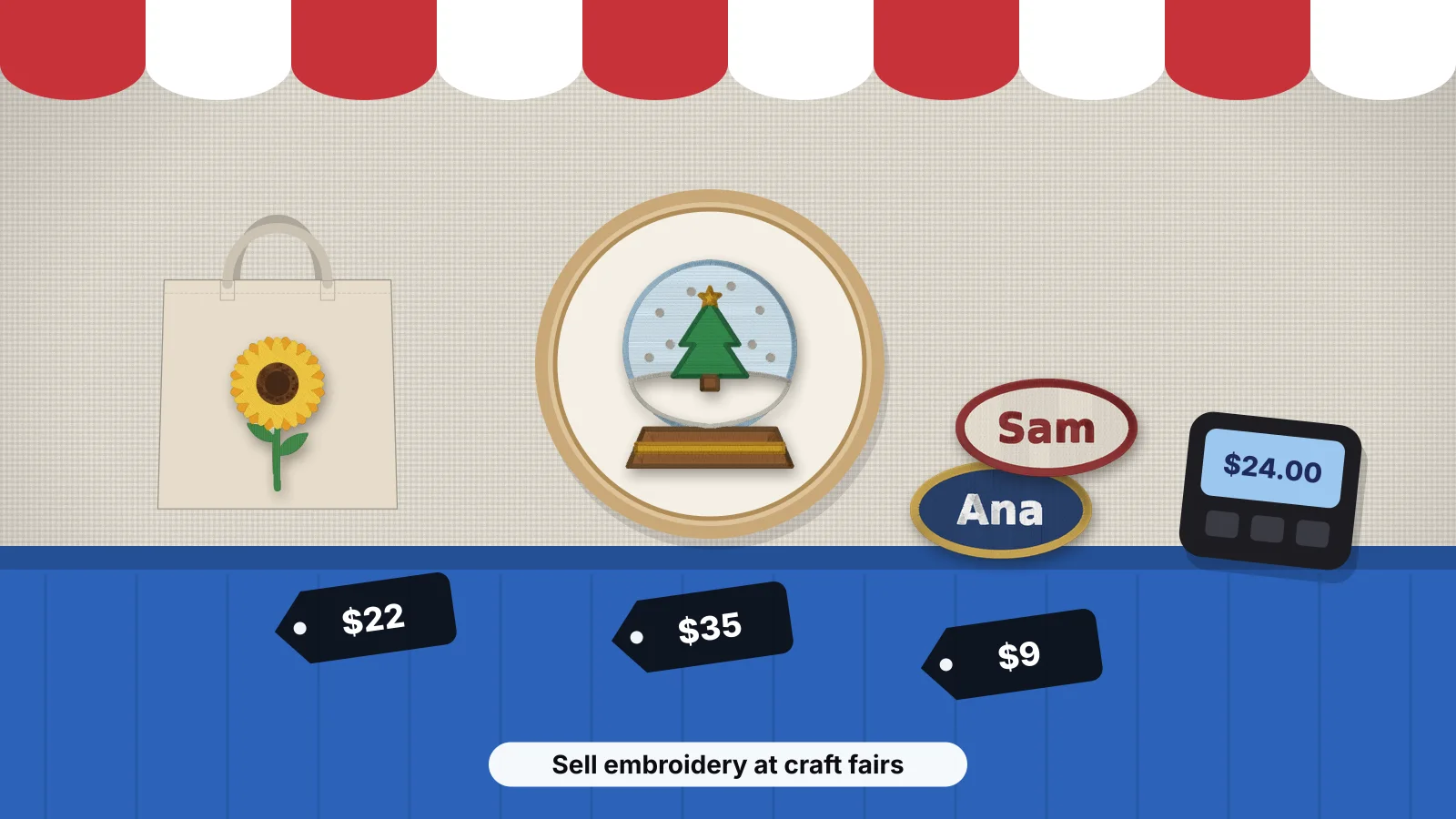
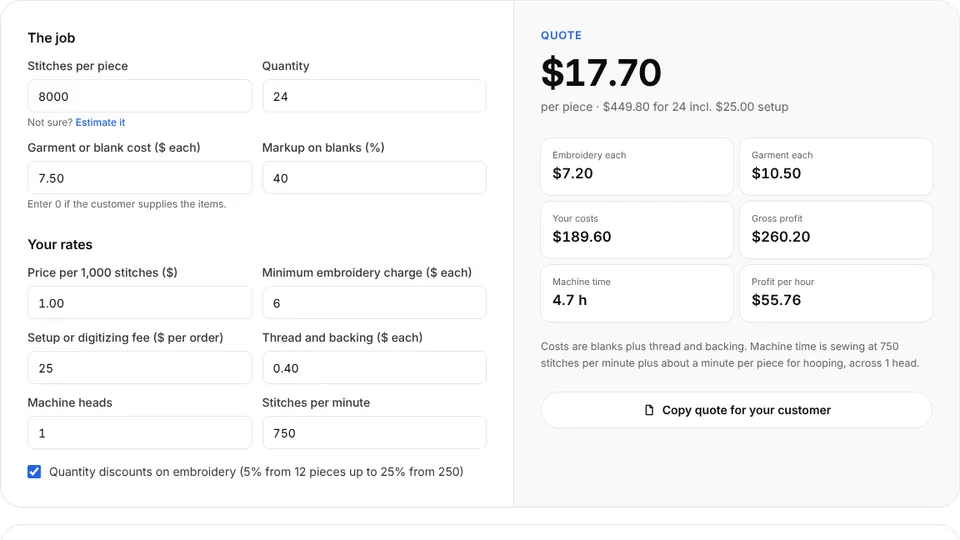
 Free toolEmbroidery pricing calculatorQuote embroidery jobs: per-1,000-stitch rates, blanks, setup fees, quantity breaks and profit.Open the tool
A craft fair is the one place where buyers can touch your stitching, and where a name stitched in 15 minutes can beat anything on the next table. It works for a home embroiderer with one single-needle machine as well as for a small shop, as long as the products, prices and queue are planned before the day.
This guide covers what sells at fairs and markets, a product mix with typical prices, booth setup and sample boards, stitching names on the spot, pricing and bundles, how much stock to bring, card payments, and turning one day into follow-up orders. For what sells online and all year, see best-selling embroidery items.
What embroidery sells best at craft fairs?
Small, giftable, personalized pieces sell best, because fair buyers decide in a minute or two and most are shopping for someone else. Build the table as a price ladder: impulse items under $15 at the front, core gifts at $15–$40, and a few showpieces that stop people walking past. These are rough ranges for local US fairs and markets in 2026; look at what similar items sell for at your event before you set yours.
| Item | Typical fair price, about | Role on the table | Good to know |
|---|---|---|---|
| In-the-hoop keychain or bag tag with a name | $8–$15 | Impulse, and the easiest item to personalize on the spot | Light, cheap and quick; see in-the-hoop keychains |
| Felt ornament with a name or year | $10–$20 | Impulse and seasonal | Sells from late October to December; see ornaments |
| Patches and bookmarks | $5–$12 | Impulse, popular with kids and teens | Show them in a basket or pinned to a board |
| Kitchen or tea towel | $12–$25 | Core gift | Sell in sets of two or three; see towels |
| Hand towel with a name or monogram | $15–$30 | Core gift, often personalized | Use a water-soluble topping on terry |
| Canvas tote bag | $20–$35 | Core gift | Hang them so the design shows; see tote bags |
| Baby bib, burp cloth or blanket | $12–$45 | Core gift for showers and new babies | Names sell; use a soft backing against the skin |
| Pet bandana | $15–$25 | Core, for dog owners | Bring a size chart; see pet bandanas |
| Sweatshirt or framed hoop art | $35–$60 | Showpiece and sample | Brings people to the table; stock a few and take orders |
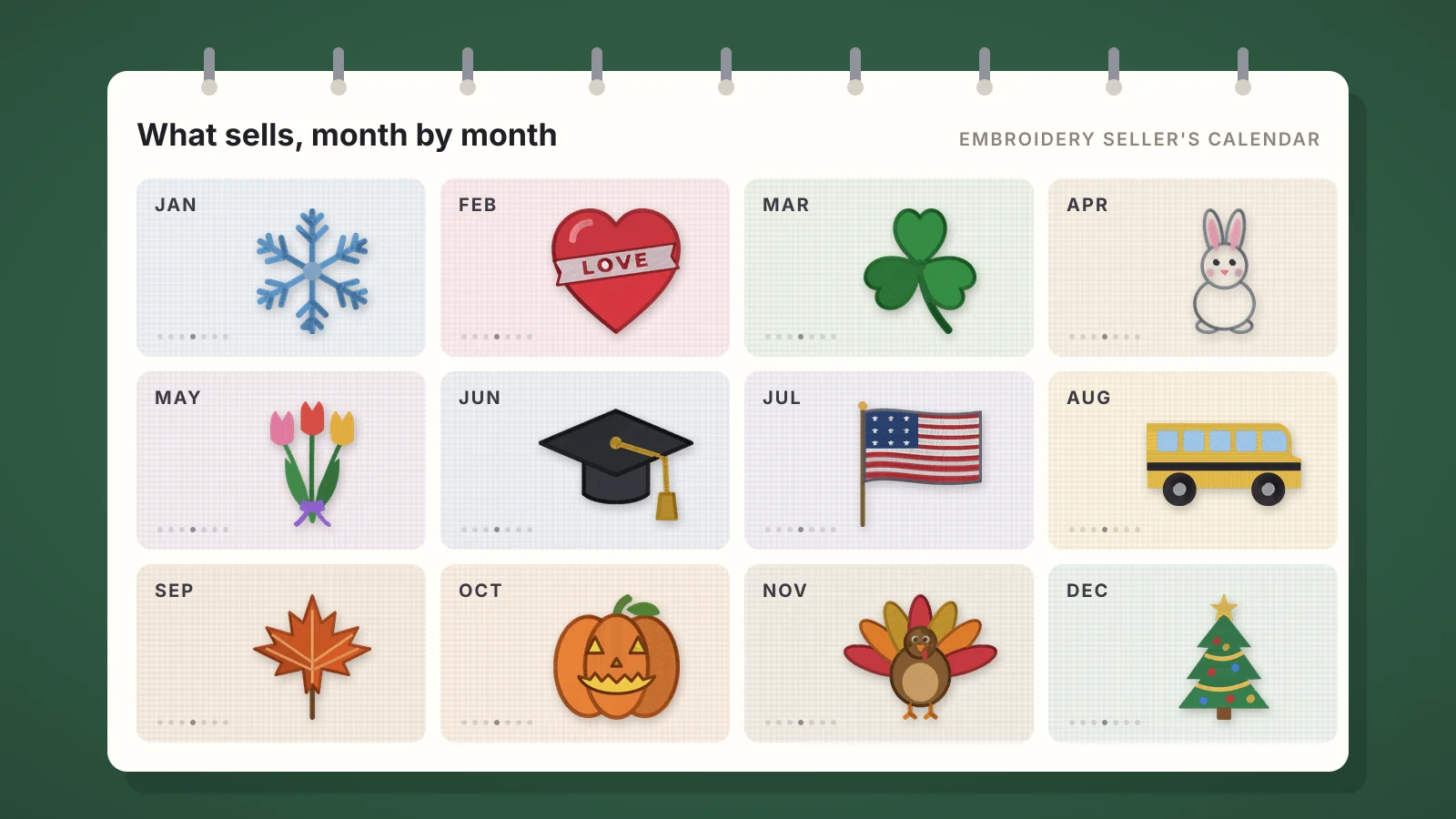
Seasonal pieces move fastest close to their holiday: fall and Halloween designs in September and October, ornaments and stockings from late October. For a November or December fair, Christmas embroidery to sell lists the season's best sellers and order deadlines, and best-selling embroidery items covers what people ask for the rest of the year. For what sells in each month, see the seller's calendar.
Keep the range tight. Five to eight products in a few colors look better and sell faster than thirty different things, because a shopper who can't take the table in at a glance usually walks on.
How should you set up an embroidery booth?
Most fairs rent a 10 × 10 ft (3 × 3 m) space, and most local shows charge roughly $25–$200 for it, with large juried shows charging more. Ask whether tables, chairs and power are included: electricity is often an extra fee, if it's offered at all. Outdoors you need a canopy and weights, and many shows require about 25–40 lb (11–18 kg) on each leg.
- One or two 6 ft tables with a cloth to the floor, so boxes and spare stock stay hidden underneath.
- Height. Crates, risers or a shelf at the back, and a rail or grid wall for totes, towels and sweatshirts. Flat items lying on a table are hard to see from the aisle.
- A font board: the same name stitched in each font you offer, numbered 1, 2, 3, on one strip of felt or fabric. Buyers point at a number instead of trying to describe a font.
- A thread color board: 8–12 stitched swatches, lettered A, B, C, so choosing a color takes a second.
- A size board with a name stitched 1, 1.5 and 2 in (25, 38 and 50 mm) tall, so people can see what fits a towel, a bib or a keychain.
- Prices on every item or group. Many shoppers won't ask, and walk on instead.
- A sign for the service, such as: Names stitched while you wait, about 15 minutes, $5.
- The small things: bags, a mirror if you sell hats, a cash box, a power bank, tape, clips and a sweater for a cold hall.
Photograph the booth once it's set up, for next year's layout and for posts before your next fair. How to photograph embroidery covers the light and the shots to take; lead with real photos of real pieces rather than mockups.
Try it with your own design
Sign up free, upload an image and get a stitch preview in under a minute.
Drop your image here
PNG, JPG, SVG, PDF or AI · stays on your device
Not sure what to expect? See real examples or how it works.
How do you stitch names while customers wait?
Bring the machine, a set of blanks that stitch fast and a short menu of choices, and run the orders as a numbered queue. Personalization at the table is the thing a fair has that a website doesn't, and it's often the best seller of the day.
- Ask about power first. You need an outlet or a battery power station that covers your machine's rating, which is on the label or in the manual. Many fairs don't allow generators, and some charge for electricity.
- Pick quick blanks: keychains, felt ornaments, bookmarks, bibs, pet bandanas and towels that float on sticky stabilizer. Leave caps and anything with seams to unpick for orders.
- Fix the menu: two or three fonts, six to ten thread colors and one or two sizes. Fewer choices mean a faster queue and fewer mistakes.
- Write every name on a numbered ticket in capitals, and have the customer check the spelling before you stitch. Give them the number and a time to come back.
- Prepare ahead. Your machine's built-in fonts are usually fastest for one-off names at the booth. Also stitch some common names in advance on cheap items such as keychains and bookmarks; the Social Security Administration publishes the most popular baby names by year and state, a good guide for kids' items.
- Keep a pre-hooped stack: sticky tear-away in two or three hoops, so you peel, press the next blank and start.
| Item | Stitches, about | Sew time at 600 stitches a minute | Wait, with hooping |
|---|---|---|---|
| Name on a felt ornament or bookmark | 1,000–2,500 | 2–4 min | About 8–10 min |
| In-the-hoop keychain with a name | 2,500–4,000, with the border | 4–7 min | About 12–15 min, with the stops |
| Name on a hand towel | 2,000–4,000 | 3–7 min | About 10–12 min |
| Name on a pet bandana | 1,500–3,000 | 3–5 min | About 8–10 min |
Keep the machine stitching, even when no one is waiting. A design sewing out draws a crowd, and people stop to ask what it's making, which is the opening for a sale.
How should you price embroidery for a fair?
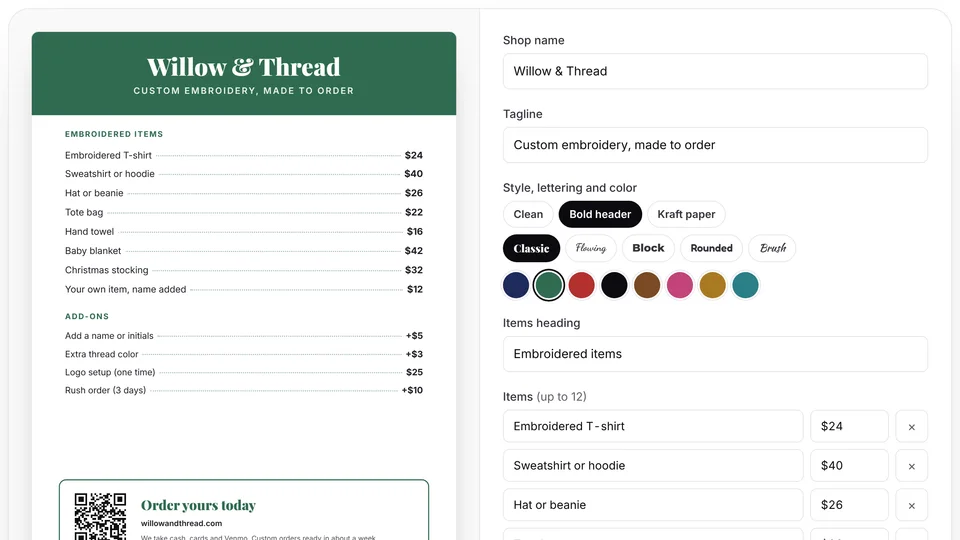
Price from your costs and time, the same way as any other order, then round to easy numbers. Use whole dollars, ideally steps of $5, so change is quick and the price signs are easy to read from the aisle. The free price list maker prints a sign with your items, add-ons and a QR code to your shop.
- Start from cost and time. Add the blank, thread, stabilizer and a stitching charge; many shops use a rate per 1,000 stitches with a minimum per piece. The embroidery pricing calculator does the sum, and how to price embroidery explains rates, minimums and markups.
- Add the fair's costs: the booth, power, travel and card fees, spread across what you expect to sell.
- Charge for personalization: a set price per name, such as $5, on top of the item. Customers expect it, and it pays for the queue.
- Bundle the core gifts: 2 ornaments for $25, 3 tea towels for $50, or a towel and a matching tote as a set. Bundles raise the average sale without cutting the price of a single piece.
- Keep fair and online prices close. A customer who finds your shop afterwards shouldn't see the same towel for much less.
A worked example: a tea towel with a $3 blank, about $0.50 of thread and stabilizer and a 4,000-stitch design at $1 per 1,000 stitches costs $7.50 before your time and the fair's costs. At $20, $25 with a name, or 3 for $50, each towel still leaves room for both. Write your prices down before the fair; deciding them at the table, one shopper at a time, usually means pricing too low.
How much stock should you bring to a craft fair?
Work back from a sales goal rather than guessing. Set a goal that covers the booth, travel and materials with something left for your time, divide it by your average sale to get the number of sales, then bring about two to three times that many items, so the table still looks full late in the day.
| Step | Example: a one-day local fair |
|---|---|
| Sales goal | $600 |
| Average sale, with bundles and names | About $20 |
| Sales needed | About 30 |
| Items to bring, at two to three times | About 60–90, plus blanks for personalizing |
| Split by item | Heavier on cheap items and best sellers: for example 25 keychains and ornaments, 20 towels, 12 totes, 10 bibs and bandanas, and a few showpieces |
For a first fair, keep the range narrow and the quantities modest, and note what sells and when. Bring plain blanks for names rather than many finished name items, since an unsold towel with one child's name on it is hard to sell to anyone else. After two or three fairs, your own sales notes are a better guide than any rule of thumb, and the embroidery business calculator shows what each fair earns after costs.
How do you take card payments at a craft fair?
Use a card reader that pairs with your phone, and keep some cash for buyers who prefer it. Many shoppers carry little cash, so a booth that can't take cards loses sales.
| Option | Cost, about (late 2026) | Good to know |
|---|---|---|
| A card reader from Square or SumUp | Reader about $50–$60; about 2.6% plus 10–15¢ per payment | Takes chip and tap payments through a phone app; check the current rate before the fair |
| Tap to Pay on a phone | No reader; card fees still apply | Square supports it on compatible iPhone and Android phones; useful as a backup |
| Cash | No fee | Bring about $100–$150 in $1, $5 and $10 bills for change |
| Payment app QR codes | Business accounts usually charge a fee | Print the code on a sign, and confirm each payment before the buyer leaves |
- Check the signal. Halls and fields often have weak signal and busy Wi-Fi. Charge the phone, bring a power bank and find out whether your app can take payments offline.
- Sales tax. Many states expect you to collect sales tax on in-person sales, and some need a seller's permit or a temporary event permit. Check with your state's revenue department, and ask the organizer.
- Deposits for custom orders go through the same reader, with a receipt by text or email. Ask before you add a receipt email to your mailing list.
How do you take orders for later and get follow-up sales?
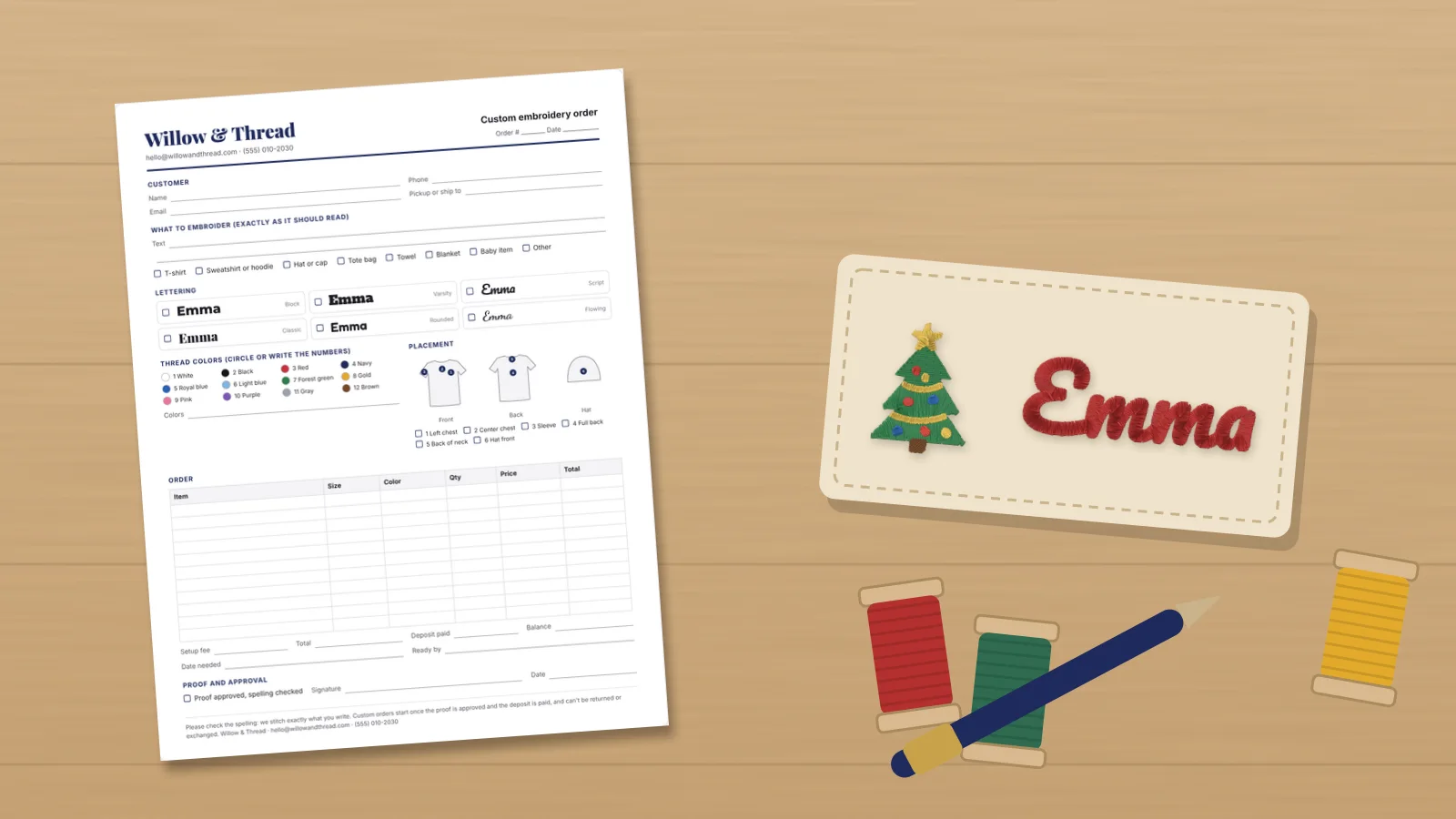
Take orders for anything you can't stitch at the table, and collect emails from everyone who'd like to hear from you. The fair lasts a day, but the people you meet can order for years. An order form needs:
| On the order form | Why |
|---|---|
| Name, phone and email | To send the proof and say when it's ready |
| Item, size and blank color | Point to the sample on the table so there's no doubt |
| Text exactly as stitched, in capitals, with the font number and thread letter from your boards | Spelling mistakes are the most common reason for a remake |
| Price, deposit paid and balance due | Many sellers take half or the full price upfront |
| Pickup, local delivery or shipping, and the date | Add shipping to the price, and set a date you can keep |
- Send a proof before you stitch: a photo of a sample or an image of the stitch file.
- Collect emails with consent: a sign-up sheet or a QR code to a form, with a free prize drawing or a small discount on the next order as the reason to join. Add only people who ask, and put an unsubscribe link in every email.
- Follow up within a few days: a thank-you, photos of new pieces, the date of your next fair and, from October, your holiday order deadline.
- Put a card in every bag, with your shop link and a QR code.
- Watch for bigger jobs. Coaches, teachers and small business owners walk past fair tables too, and one team or staff order can be worth more than the whole day. How to get embroidery customers covers reaching them.
Practice on a free design
167 ready-to-sew designs in every machine format, free with an account.
Using Embrizo to get ready for a fair
Embrizo is most useful before the fair, turning names, logos and artwork into stitch files in the browser:
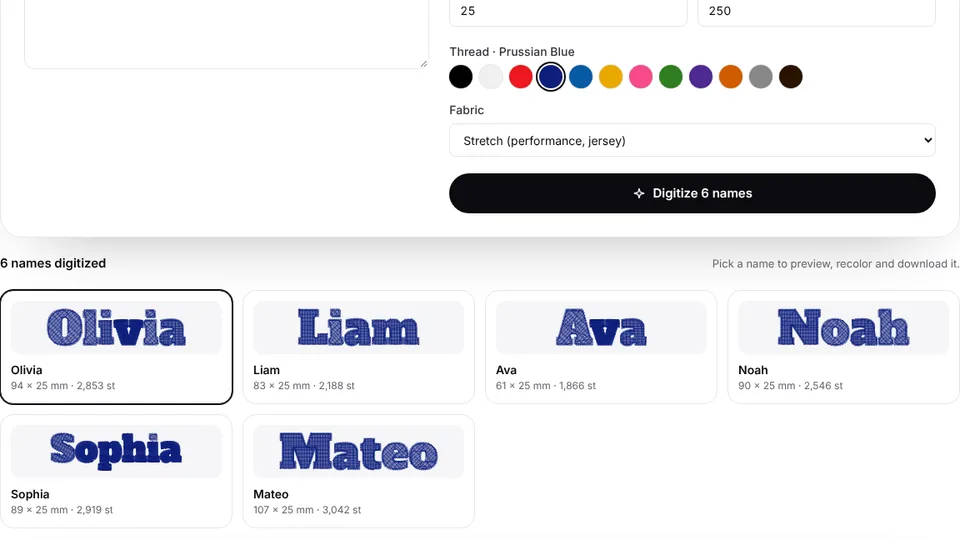
- Names in bulk: batch name embroidery digitizes up to 30 names per batch in the same font, height and thread, and flags any wider than your item, for pre-stitched keychains, ornaments and bookmarks.
- Fonts your machine doesn't have: text to embroidery for names and the monogram maker for initials.
- Sheets of small items: the hoop layout tool fills a hoop with copies of one design, sewn color by color, for ornaments, patches and keychains.
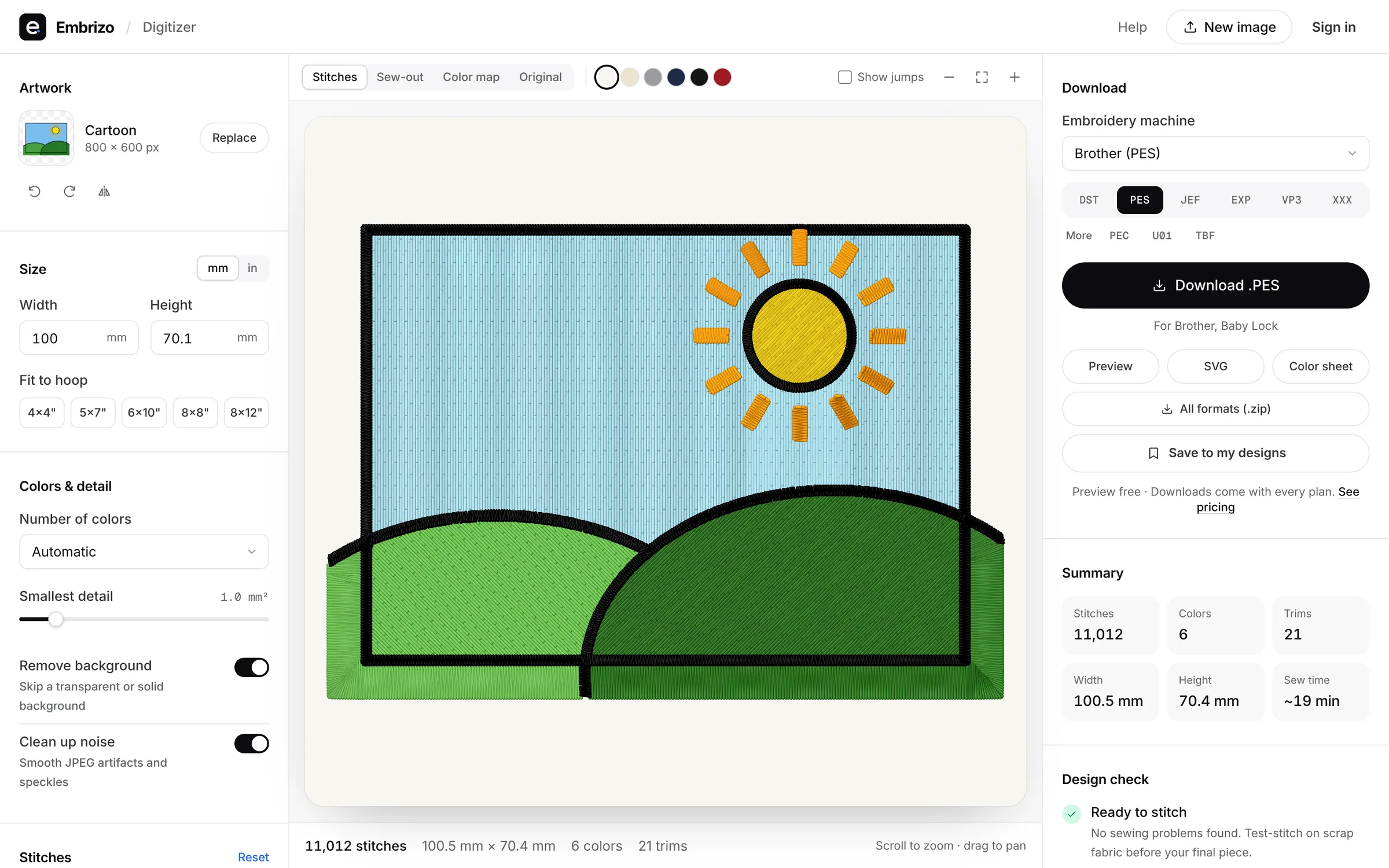
- Designs nobody else at the fair has: upload a drawing, such as your town's name with a simple landmark, to the digitizer. It picks satin, fill or running stitch for each shape and shows a stitch preview before you sew.
- Ready-made motifs: over 100 free designs, free with an account. You can stitch them on items you sell, but you can't sell or share the files.
Designing, digitizing and previews are free with an account; downloading files needs a plan. Embrizo doesn't run your machine, take payments or print order forms, and at the booth your machine's built-in fonts are usually the quickest way to stitch a one-off name.