Machine embroidery FAQ
109 common questions about embroidery files, sizes, hoops, machines and stitches, each with a short answer and a link to the full page.
Files and formats
- What is the most common embroidery file format?
- DST is the most widely read format, especially on commercial machines, and almost all embroidery software opens it. Home machines usually prefer their brand's own format because it keeps the thread colors.
- Full answer
- Is PES or DST better?
- Neither stitches better; the stitches are the same. PES is better on Brother and Baby Lock machines because it carries thread colors. DST is better for commercial machines and shops because almost everything reads it.
- Full answer
- How do I open a PES file on my computer?
- Drop it into a browser-based embroidery file viewer, which shows the stitches, colors, size and stitch count. Brother's embroidery software opens PES too, and so does most other embroidery software.
- Full answer
- What is the difference between PES and JEF?
- PES is Brother's format, used by Brother and Baby Lock home machines; JEF is Janome's, used by Janome and Elna home machines. Both store thread colors. The stitches are the same in both, so use the one your machine reads and convert when you need the other.
- Full answer
- What is the difference between PES and EXP?
- PES is Brother's format, used by Brother and Baby Lock home machines; EXP is Melco's, used by Melco commercial and Bernina home machines. PES stores thread colors; EXP doesn't, so keep a color sheet with it. The stitches are the same in both, so use the one your machine reads and convert when you need the other.
- Full answer
- What is the difference between PES and VP3?
- PES is Brother's format, used by Brother and Baby Lock home machines; VP3 is Husqvarna Viking / Pfaff's, used by Husqvarna Viking and Pfaff home machines. Both store thread colors. The stitches are the same in both, so use the one your machine reads and convert when you need the other.
- Full answer
- What is the difference between PES and XXX?
- PES is Brother's format, used by Brother and Baby Lock home machines; XXX is Singer / Compucon's, used by Singer home machines. Both store thread colors. The stitches are the same in both, so use the one your machine reads and convert when you need the other.
- Full answer
- What is the difference between DST and JEF?
- DST is Tajima's format, used by commercial multi-needle machines; JEF is Janome's, used by Janome and Elna home machines. JEF stores thread colors; DST doesn't, so keep a color sheet with it. The stitches are the same in both, so use the one your machine reads and convert when you need the other.
- Full answer
- What is the difference between DST and EXP?
- DST is Tajima's format, used by commercial multi-needle machines; EXP is Melco's, used by Melco commercial and Bernina home machines. Neither stores thread colors, so keep a color sheet with the file. The stitches are the same in both, so use the one your machine reads and convert when you need the other.
- Full answer
Sizes and hoops
- What size is a left chest embroidery design?
- A left chest embroidery logo is usually 3 to 4 inches (75–100 mm) wide and no more than about 3 inches (75 mm) tall. It sits about 7–9 inches below the shoulder seam at the collar and 3.5–5 inches from the center front.
- Full answer
- What size is a right chest embroidery design?
- A right chest embroidery design is usually 2 to 3.5 inches (50–90 mm) wide. It mirrors the left chest on the wearer's right, at the same height, and is often used for a name, a title or a second, smaller logo.
- Full answer
- What size is a center chest embroidery design?
- A center chest embroidery design is usually 4 to 8 inches (100–200 mm) wide, centered on the front with the top about 3–4 inches below the collar. It suits medium logos, crests and short slogans on sweatshirts, hoodies and tees.
- Full answer
- What size is a full front embroidery design?
- A full front embroidery design is usually 8 to 12 inches (200–300 mm) wide, centered with the top about 3–4 inches below the collar. Designs this size need a large hoop, often 8×12 in or bigger, and a stable cut-away backing.
- Full answer
- What size is a back of the neck embroidery design?
- A back-of-the-neck embroidery design is usually 2 to 4 inches (50–100 mm) wide and about 0.5–1.5 inches tall, centered 1–2 inches below the back collar seam. It's popular for small logos, websites and short words.
- Full answer
- What size is a full back embroidery design?
- A full back or jacket back embroidery design is usually 10 to 12 inches (250–300 mm) wide, centered with the top about 3–5 inches below the collar. It needs a large hoop or a design split into sections, and heavy cut-away backing.
- Full answer
- What size is an upper sleeve embroidery design?
- An upper sleeve embroidery design is usually 2.5 to 3.5 inches (65–90 mm) wide, placed on the outside of the sleeve about 2–4 inches below the shoulder seam. Flags, small logos and short words work best.
- Full answer
- What size is a cap front embroidery design?
- A cap front embroidery design is usually 4 to 5 inches (100–125 mm) wide and no more than about 2–2.25 inches (50–57 mm) tall, centered on the front panel just above the brim. Low-profile caps take slightly less height.
- Full answer
- What size is a cap side embroidery design?
- A cap side embroidery design is about 1–1.5 inches (25–40 mm) tall and usually no more than 2–3 inches wide, placed on a side panel clear of the seams and eyelets. Flags, numbers and small icons work best.
- Full answer
- What size is a cap back embroidery design?
- A cap back embroidery design is about 1 inch (25 mm) tall and usually 2–3 inches (50–75 mm) wide, centered above the strap opening. Websites, names and small logos are common.
- Full answer
- What size is a beanie cuff embroidery design?
- A beanie embroidery design is usually 2 to 4 inches (50–100 mm) wide and under about 1.75 inches (45 mm) tall, centered on the folded cuff. Bold logos and short words work best on rib knit.
- Full answer
- What size is a tote bag embroidery design?
- A tote bag embroidery design is usually 5 to 10 inches (125–250 mm) wide, centered a little above the middle of the front panel. On a standard 15-inch tote, 7–8 inches wide is a common, balanced size.
- Full answer
- What size is a bath towel embroidery design?
- Bath towel names and monograms are usually about 2 to 4 inches (50–100 mm) tall, centered on or just above the woven border. The width follows the name, often 6 to 12 inches.
- Full answer
- What size is a hand towel embroidery design?
- Hand towel embroidery is usually about 1.5 to 2 inches (40–50 mm) tall, centered on or just above the woven border, with the width set by the name or monogram, often 3 to 6 inches.
- Full answer
- What size is a 4x4 embroidery hoop?
- A 4x4 embroidery hoop has a sewing field of about 100 × 100 mm (3.9 × 3.9 in). Keep designs about 3 mm inside each edge, so the largest design is roughly 94 × 94 mm.
- Full answer
- What size is a 5x7 embroidery hoop?
- A 5x7 embroidery hoop has a sewing field of about 130 × 180 mm (5.1 × 7.1 in). Keep designs about 3 mm inside each edge, so the largest design is roughly 124 × 174 mm.
- Full answer
- What size is a 6x10 embroidery hoop?
- A 6x10 embroidery hoop has a sewing field of about 160 × 260 mm (6.3 × 10.2 in). Keep designs about 3 mm inside each edge, so the largest design is roughly 154 × 254 mm.
- Full answer
- What size is a 8x8 embroidery hoop?
- A 8x8 embroidery hoop has a sewing field of about 200 × 200 mm (7.9 × 7.9 in). Keep designs about 3 mm inside each edge, so the largest design is roughly 194 × 194 mm.
- Full answer
- What size is a 8x12 embroidery hoop?
- A 8x12 embroidery hoop has a sewing field of about 200 × 300 mm (7.9 × 11.8 in). Keep designs about 3 mm inside each edge, so the largest design is roughly 194 × 294 mm.
- Full answer
- What size is a 9.5x14 embroidery hoop?
- A 9½x14 embroidery hoop has a sewing field of about 240 × 360 mm (9.4 × 14.2 in). Keep designs about 3 mm inside each edge, so the largest design is roughly 234 × 354 mm.
- Full answer
Free account
Questions answered. Now make something.
Create a free account to digitize any image, try every setting and watch it sew. Choose a plan only when you want to download files.
- Digitize and preview any image
- Realistic stitch preview and sew-out
- Download free ready-made designs
- No credit card needed

Machines
- Can Brother machines read DST files?
- Many can, for example the PE800. The design loads in default colors, though, so PES is the better choice when you have it.
- Full answer
- Do Baby Lock machines use the same files as Brother?
- Yes. Baby Lock and Brother embroidery machines both use PES, so the same file works on either.
- Full answer
- Can Janome machines read PES files?
- Most Janome home machines list only Janome formats such as JEF, JEF+ and JPX. Convert PES files to JEF before loading them.
- Full answer
- Can this tool make ART files for Bernina?
- No. ART is Bernina's software format. The digitizer makes EXP, which most current Bernina embroidery machines read directly.
- Full answer
- Will VP3 files work on older Husqvarna Viking machines?
- Machines from the VP3 era read it. Some older models only read HUS or VIP, which this tool doesn't write, so check the formats your machine lists.
- Full answer
- Do Pfaff and Husqvarna Viking use the same file format?
- Yes. Both use VP3, so a VP3 file from the digitizer works on either brand.
- Full answer
- Which Singer machines use XXX files?
- The Singer Futura series and other Compucon-based Singer machines. Newer models vary, so check your manual.
- Full answer
- Does a DST file include thread colors?
- No. DST marks where colors change but not which colors. Use the color sheet to set up your needles.
- Full answer
- What file format does a Ricoma embroidery machine use?
- DST. Ricoma's commercial machines read the Tajima DST format, the common format of multi-needle machines.
- Full answer
- Should I use EXP or DST on a Melco?
- Either works. EXP is Melco's own format; DST is easier to share with shops that run other machines.
- Full answer
- What is a U01 file?
- U01 is a Barudan stitch format. It stores stitches, trims and needle changes for Barudan commercial embroidery machines.
- Full answer
Stitches, fabric and lettering
- How many stitches is an embroidery design?
- A typical left chest logo (3.5 × 2.25 in) has about 4,200 stitches and a 4 × 4 in design about 8,500. Light lettering comes in around 25% lower and a design filled edge to edge around 25% higher.
- Full answer
- What is satin stitch in embroidery?
- Closely spaced stitches that zigzag across a narrow shape from edge to edge, giving the smooth, shiny look of embroidered lettering.
- Full answer
- What is fill stitch in embroidery?
- Rows of stitches that cover the larger areas of a design; tatami is the most common kind.
- Full answer
- What is underlay in embroidery?
- A light layer of stitches sewn first under the visible stitching, to anchor the fabric to the stabilizer and keep the top stitches from sinking.
- Full answer
- What is pull compensation in embroidery?
- Extra width added to shapes so they sew at the drawn size, because each stitch pulls the fabric in along its direction.
- Full answer
- What is density (stitch spacing) in embroidery?
- How closely stitches are packed, usually given as the distance between fill rows or satin stitches in millimeters: smaller numbers mean denser.
- Full answer
- What is stabilizer in embroidery?
- Material hooped with the fabric to support the stitches, so the design keeps its shape and the fabric doesn't pucker.
- Full answer
- What is digitizing in embroidery?
- Turning artwork into a machine embroidery file by choosing stitch types, directions, density, underlay and sewing order for every shape.
- Full answer
- What is trim in embroidery?
- A command that makes the machine cut the threads before moving to a new area, so no loose jump threads are left behind.
- Full answer
- What is the smallest size for block embroidery lettering?
- Block is a bold sans embroidery lettering style based on the open-source Montserrat font. Keep capital letters at least 5 mm tall so the stitches stay readable.
- Full answer
- What is the smallest size for slab embroidery lettering?
- Slab is a classic serif embroidery lettering style based on the open-source Roboto Slab font. Keep capital letters at least 7 mm tall so the stitches stay readable.
- Full answer
- What is the smallest size for tall embroidery lettering?
- Tall is a condensed caps embroidery lettering style based on the open-source Bebas Neue font. Keep capital letters at least 6 mm tall so the stitches stay readable.
- Full answer
- What is the smallest size for varsity embroidery lettering?
- Varsity is a heavy slab embroidery lettering style based on the open-source Alfa Slab One font. Keep capital letters at least 6 mm tall so the stitches stay readable.
- Full answer
Projects and business
- Can I digitize a logo for free?
- Yes. Create a free account and you can digitize and preview it without paying. The digitizer runs in your browser, so your logo is never uploaded.
- Full answer
- What is the maximum width for satin stitch?
- A common working limit is about 7 mm; wider columns are split into shorter stitches or filled. Embrizo's digitizer uses satin up to 6.5 mm and fills anything wider.
- Full answer
- Is a 5×7 hoop exactly 5 by 7 inches?
- Not quite. The usual 5×7 sewing field is 130 × 180 mm, which is about 5.1 × 7.1 inches. Brands round slightly differently.
- Full answer
- What stabilizer should I use for T-shirts?
- Cut-away, or a no-show mesh on light colors. T-shirt knits stretch, and cut-away keeps supporting the design through washing.
- Full answer
- What is the smallest text you can embroider?
- Around 4 mm capitals in a very simple font, usually sewn as running stitch or with thinner thread. For reliable results, keep capitals at least 5 mm tall.
- Full answer
- What resolution should an image be for embroidery digitizing?
- Around 1,000 to 2,000 pixels across. That gives enough pixels per millimeter to measure thin lines accurately at common logo sizes.
- Full answer
- How much does it cost to digitize a logo?
- A digitizing service typically charges per design, often roughly $10–$50 or more for a typical logo depending on size and stitch count. On an Embrizo plan, a design costs $1.00 or less if you use all your monthly downloads, and about $0.40 on Hobby billed yearly.
- Full answer
- How big can a logo be on a hat?
- On most structured caps, about 2–2.25 in (50–57 mm) tall and 4–5 in (100–125 mm) wide. Unstructured and low-profile caps have less room, around 1.75–2 in tall.
- Full answer
- What fabric is best for embroidered patches?
- Twill is the classic choice: firm, smooth and available in many colors. Felt is a good, cheap alternative because it doesn't fray. Pick a color close to the patch background.
- Full answer
- Can any drawing be turned into embroidery?
- Most can. Bold lines, solid colors and a clean scan give the best results. Faint pencil, crayon texture and very fine detail need tracing over or a larger size first.
- Full answer
- What is the best font for embroidery?
- A bold sans-serif with even strokes, often called a block font. It stays readable down to about 5 mm tall and sews as clean satin. Serifs and scripts work too, but need more size.
- Full answer
- Where does a left chest logo go?
- On the wearer's left side, about 7–9 in (180–230 mm) below the shoulder seam at the collar and about 3.5–5 in (90–125 mm) from the center front. Adjust for smaller garment sizes.
- Full answer
- How much should I charge per 1,000 stitches?
- Work it out from your hourly target and realistic stitches per hour. Many shops land somewhere around $0.75–$1.50 per 1,000 stitches on typical orders, with a minimum of a few dollars per piece, but rates vary widely by region, machine and order size.
- Full answer
- How much does it cost to start an embroidery business from home?
- The machine is the biggest cost. A single-needle home machine runs from a few hundred dollars to several thousand, and a multi-needle machine often roughly $5,000–$15,000 or more. Blanks, thread, stabilizer and hoops typically add a few hundred dollars to start, and digitizing on Embrizo starts at $8 a month billed yearly.
- Full answer
- What stabilizer do you use for a hoodie?
- A medium cut-away on the back and a water-soluble topping on the front. Fleece stretches, so tear-away alone often lets the design distort after washing, and without a topping thin stitches sink into the surface.
- Full answer
- Do you need a topping to embroider towels?
- Yes, on looped terry. A water-soluble topping keeps the stitches on top of the loops, so lettering and edges stay visible. Flat-woven tea towels don't need one.
- Full answer
- What is the best thread for machine embroidery?
- 40-weight polyester suits most jobs. It's strong, colorfast and stands up to frequent washing. Rayon has a softer sheen and suits items that are washed gently.
- Full answer
- Why is my embroidery puckering?
- Usually the backing is too light for the fabric or the fabric was stretched in the hoop. Use cut-away on knits, hoop flat without stretching, and use a file made for the fabric.
- Full answer
- What is a good stitch density for embroidery?
- For tatami fill with 40-weight thread, around 0.4 mm between rows is a common starting point. Knits and stretch fabrics often go a little lighter, around 0.43–0.45 mm, and leather around 0.5 mm.
- Full answer
- What do I need to start machine embroidery?
- An embroidery machine and hoop, stabilizer, 40-weight embroidery thread, bobbin thread, 75/11 embroidery needles, small scissors and a design in your machine's format. Start with medium tear-away for wovens and cut-away for knits.
- Full answer
- What is machine appliqué?
- A technique where a piece of fabric is stitched onto a base fabric instead of filling the shape with stitches. The file sews a placement line, a tack-down and, after you trim, a satin cover over the cut edge.
- Full answer
- What size needle is best for machine embroidery?
- 75/11 suits most machine embroidery with 40-weight thread. Go down to 65/9 or 70/10 for 60-weight thread and fine fabrics, and up to 80/12 or 90/14 for denim, canvas and thick layers.
- Full answer
- What size should a logo be on a polo shirt?
- About 3–4 in (75–100 mm) wide and up to about 3 in tall on the left chest of adult polos; 3.5 in (90 mm) is the most common. Kids' sizes usually look better at about 2.5–3 in (65–75 mm).
- Full answer
- What stabilizer is best for baby clothes?
- No-show mesh or a light cut-away on knit bodysuits and sleepers, because it's soft and keeps supporting the design through washing. Cover the back with a soft fusible cover backing so the stitches don't rub.
- Full answer
- What needle do you use to embroider denim?
- An 80/12 sharp for most jeans and jackets, and a 90/14 sharp or a jeans needle for heavy denim or near seams. Lightweight chambray takes a 75/11 sharp.
- Full answer
- What embroidered items sell well on Etsy?
- Personalized items are a common focus: names on towels, blankets and stockings, monograms, baby gifts, pet portraits, kids' drawings and patches or logos for small businesses. A focused niche is easier to find and photograph well than a bit of everything.
- Full answer
- Can you turn any photo into embroidery?
- Most photos can be digitized, but only some stitch well. One clear subject, strong contrast and a plain background work best. Busy scenes, group photos and dark or blurry shots lose too much when they're reduced to a few thread colors.
- Full answer
- How big is a jacket back embroidery design?
- Usually about 10–12 in (250–300 mm) wide on adult jackets, 8–10 in on hoodies and 9–11 in on vests. Measure the garment flat between the side seams and leave a few inches of margin.
- Full answer
- What stabilizer do you use for T-shirts?
- Cut-away or no-show mesh, because jersey stretches and the backing has to keep supporting the stitches after washing. Use no-show mesh for light designs and pale shirts, medium cut-away for a typical logo and heavy cut-away or two layers for dense designs.
- Full answer
- What size should a beanie logo be?
- About 2–4 in (50–100 mm) wide and under about 1.75 in (45 mm) tall, so it fits the folded cuff with a margin. A small icon of about 1.5–2 in works too. Measure the cuff, since depth varies by style.
- Full answer
- How big should embroidery be on a tote bag?
- About 6–8 in (150–200 mm) wide on a standard 15 in tote, centered with its top about 2–3 in below the top hem. Small totes look best around 4–6 in, and large beach totes take up to about 10 in.
- Full answer
- Can you machine embroider leather?
- Yes, on a home or commercial machine, with care. Float the leather on sticky backing instead of hooping it, choose a light design with wider stitch spacing, use a sharp or leather needle and test on a scrap of the same leather first.
- Full answer
- Where does embroidery go on a pillowcase?
- Usually at the open end: centered on the hem band, or about 1–2 in above it on the body of the case. That keeps the stitches out of the middle, where a face rests, and shows them when the bed is made.
- Full answer
- What stabilizer do you use to embroider a fleece blanket?
- A medium cut-away underneath, or no-show mesh for light designs, and a water-soluble topping on top. The topping keeps the stitches on the surface of the pile, and the cut-away supports them through washing.
- Full answer
- Where do you put a logo on an apron?
- Centered on the bib with its top about 2–3 in below the top edge, or on the wearer's left chest like a shirt, with a name on the right. Waist aprons usually carry the logo on the pocket or just above it.
- Full answer
- Can you embroider a backpack with a home machine?
- Often, on the front pocket. Open the zip and slide the hoop inside so only the pocket's front fabric is hooped, or float it on sticky backing. Padded panels and straps can't be hooped; use a patch there.
- Full answer
- Where do you put a monogram on a napkin?
- In one corner, centered on the diagonal, with the edge of the design about 1.5–2 in (40–50 mm) from both hemmed edges on a dinner napkin. Fold the napkin first to see which corner shows and which way up the monogram should face.
- Full answer
- Can you machine embroider a knit sweater?
- Yes. Use a water-soluble topping, a cut-away or no-show mesh underneath, a ballpoint needle and a file with heavy underlay. Float the sweater or use a magnetic hoop so the knit isn't stretched.
- Full answer
- Why won't my embroidery machine read my USB stick?
- Common causes are a stick that's too large for the machine or formatted as exFAT or NTFS instead of FAT32. Use a small FAT32 stick, copy the design to the top level rather than a folder and keep the file name short. Some manuals also give a maximum stick size.
- Full answer
- Why does my embroidery machine show no designs on the USB stick?
- Usually the stick isn't formatted as FAT32, it's larger than the machine can read, or the files are inside a folder or a ZIP. Format a small stick as FAT32, unzip the download and copy your machine's file to the top level.
- Full answer
- How much can you resize an embroidery design?
- About 10% either way sews like the original, and up to about 20% usually works after a test sew-out. Beyond that, digitize the original artwork again at the new size, because the density changes too much.
- Full answer
- Is embroidery or screen printing more expensive?
- It depends on the order. Screen printing has a setup cost for each color, so it's usually cheaper per piece on large runs of T-shirts. Embroidery's cost follows the stitch count, so small logos in small or medium quantities are often competitive, while large designs cost more.
- Full answer
- Is embroidery or HTV more durable?
- Embroidery, in most cases. It's stitched into the fabric, so it can't peel or crack, and it usually outlasts the item. HTV lasts well when pressed correctly, but edges can lift and vinyl can crack after many washes.
- Full answer
- What size embroidery machine should I buy?
- For names, monograms and small gifts, a 4×4 in field is enough. A 5×7 in field covers many home projects, such as tote bags and larger chest designs, and 6×10 in or larger lets you sew big designs in one hooping.
- Full answer
- What is the correct order for monogram letters?
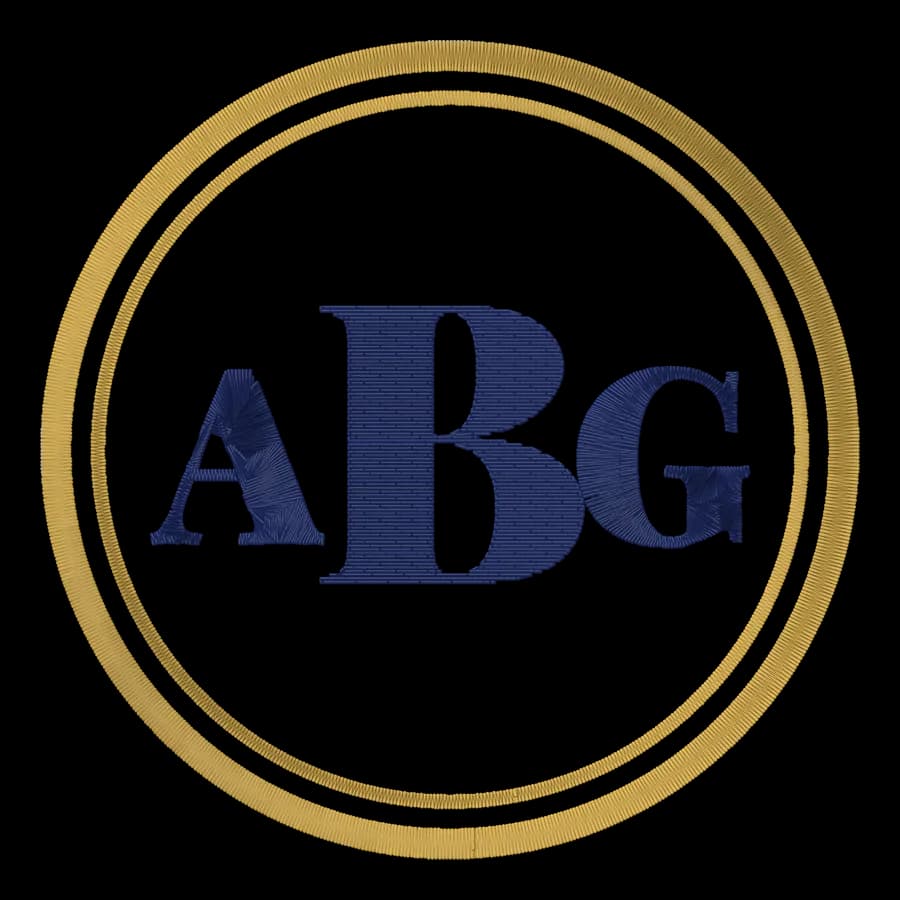
- For one person with a larger middle letter: first initial, last initial, middle initial, with the last initial in the center. Anna Grace Brown becomes A B G with a large B. If the letters are all the same size, use first, middle, last: A G B.
- Full answer
- Can I sell items made with embroidery designs I bought?
- Often, but it depends on the license. Many designers allow selling finished stitched items; some require a commercial license or limit quantities. You can't sell or share the design files themselves.
- Full answer
- What size should embroidered names be?
- It depends on the placement: capitals about 8–13 mm tall for a name on a shirt, at least 6–7 mm on a cap, a script about 25 mm or more on a towel and about 40–50 mm on a baby blanket. Never go below the font's minimum.
- Full answer
- How do I match embroidery thread to a logo color?
- Start from the logo's hex, RGB or Pantone value, find the nearest threads in a thread chart or color matcher, then compare the best two or three against a physical thread card in daylight and on the actual fabric before you commit.
- Full answer
About Embrizo
- How much does Embrizo cost?
- Digitizing is free. With a free Embrizo account you can upload an image, digitize it, change every setting, watch the stitch preview and sew-out, run the design check and save a PNG preview. Downloading embroidery files such as DST, PES or JEF needs a paid plan: Hobby ($20 a month, 20 design downloads), Shop ($50 a month, 100) or Pro ($100 a month, unlimited).
- Full answer
- How do I convert a PNG or JPG into an embroidery file?
- Open the digitizer, sign in with your free account and upload your image. It separates the colors, picks a stitch type for each shape and shows a stitch preview. Set the size to fit your hoop, check the thread colors, and download the format your machine reads.
- Full answer
- Which embroidery file formats can I download?
- DST (Tajima and commercial machines), PES (Brother, Baby Lock), JEF (Janome, Elna), EXP (Melco, Bernina), VP3 (Husqvarna Viking, Pfaff) and XXX (Singer), plus PEC (older Brother), U01 (Barudan) and TBF (newer Tajima). You also get a PNG preview, SVG stitch paths, a color sheet, and a ZIP with every format at once.
- Full answer
- Is my image uploaded to a server?
- No. Your image is processed entirely on your own device in your web browser and is never uploaded. When you download, only the finished stitch data is sent to create your file.
- Full answer
- Do I need an account?
- Yes. You need a free Embrizo account to use the digitizer and to save designs to My designs. Sign in with Google or an email link.
- Full answer
- What kind of images work best?
- Logos, lettering, clip art, icons and flat illustrations with clear shapes and solid colors give the best results. Photos work too, but they are simplified into a few flat thread colors, so cap the number of colors for cleaner results.
- Full answer
- How does the AI choose satin, fill and running stitches?
- It measures every shape. Narrow shapes such as lettering, outlines and borders get satin stitches. Large areas get tatami fill with underlay.
- Full answer
- How large can my embroidery design be?
- Anything from about 1 cm to 40 cm. One-click presets fit the design to common hoops: 4×4, 5×7, 6×10, 8×8 and 8×12 inches.
- Full answer
Still have a question? Try it.
Sign up free, upload a logo or picture and see exactly how it stitches for your machine.