Denim is one of the best fabrics to embroider. It's a firm, stable woven that holds a standard density without puckering, and florals, patches and lettering look at home on it. What makes it tricky isn't the fabric but the garments: thick seams, rivets, narrow jeans legs and heavy jackets that fight the hoop.
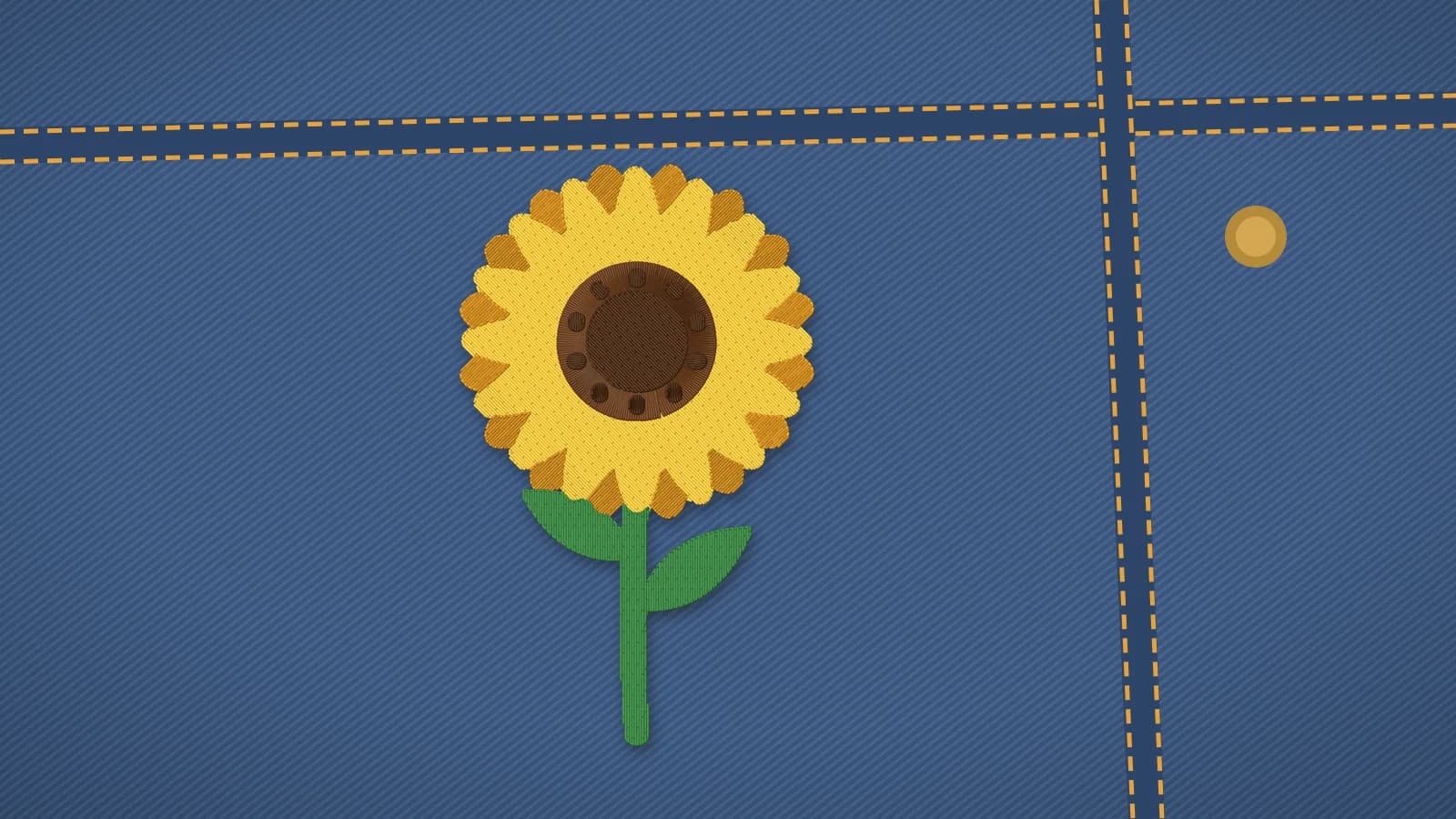
This guide covers the needle and backing, how to work around seams and hardware, how to hoop jeans and jackets, and how to plan a large design for a jacket back. For a quick start, the free sunflower design was made for denim and canvas.
Needles and thread for denim
| Denim | Needle | Notes |
|---|---|---|
| Chambray and light denim shirts | 75/11 sharp | Treat it like a woven shirt |
| Jeans and jackets (medium weight) | 80/12 sharp | The usual choice for most denim |
| Heavy denim, near seams, several layers | 90/14 sharp or a jeans needle | A stronger shaft resists deflecting and breaking |
Use a sharp point, not a ballpoint: it pierces the tight twill weave cleanly. A jeans needle has an extra-strong shaft for thick denim, but its eye is smaller than an embroidery needle's, so slow the machine down if the thread starts to shred. The needle guide covers sizes and points in detail.
Standard 40-weight polyester thread works well. Gold, mustard and white are classic on blue denim, and metallics look good as accents, with a metallic or large-eye needle at a slower speed. On raw or dark indigo denim, dye can rub off onto light thread during stitching and wear, so prewash the garment when you can.
Tear-away or cut-away for denim?
Rigid denim is stable enough for tear-away, which leaves a neat inside. Move up to cut-away when the design is dense or the denim stretches:
| Design or fabric | Backing | Topping |
|---|---|---|
| Light: text, outlines, open designs | Medium tear-away (about 2 oz) | Not needed |
| Medium: a typical logo or floral | Medium-heavy tear-away (about 2.5 oz) | Not needed |
| Dense: full fills, patches, big designs | Two layers of tear-away, or a cut-away | Not needed |
| Stretch denim (with elastane) | Cut-away, like a knit | Not needed |
| Large jacket backs | Cut-away, or two layers of tear-away | Not needed |
Two layers of medium tear-away often support a dense fill better than one heavy layer. Stretch denim is the exception that catches people out: it moves like a knit, so tear-away alone can leave the design puckered once the jeans are worn. The stabilizer finder suggests a backing for each fabric and density.
Try it with your own design
Sign up free, upload an image and get a stitch preview in under a minute.
Drop your image here
PNG, JPG, WebP or SVG · stays on your device
Seams, rivets and pockets
Thick seams are denim's main hazard. Flat-felled seams, belt loops and pocket edges can be four or more layers of heavy fabric, and the needle deflects when it hits them. That leaves gaps in the design, breaks needles, and a hard strike can knock the machine's timing out.
- Keep the design clear of seams with a margin of about half an inch (12 mm). Plan the size around the flat area, not the whole panel.
- Never stitch near rivets, buttons or zips. Metal stops the needle dead. Make sure the hoop and presser foot clear them too.
- Back pockets: unpick the pocket, embroider it flat and sew it back on, or float the jeans so only the pocket's top layer is stitched. Stitching a pocket in place sews it shut.
- If a design must cross a seam, choose bold fills that cross a flat seam well, and keep fine lettering off it.
Hooping thick denim and jeans legs
Denim is stiff, so it doesn't stretch in the hoop, but heavy denim can be too thick for the rings to close without force. Forcing them leaves a crushed ring that can show on dark denim. Options:
- A sturdy or magnetic hoop clamps thick denim evenly without forcing the rings.
- Floating: hoop adhesive backing on its own, or a regular backing with spray adhesive, then press the denim on top. Many machines can add a basting box to hold it.
- Jeans legs: a leg is a narrow tube that rarely fits around a hoop. Opening part of a leg seam, usually the outside one, lets the leg lie flat; sew it closed afterwards. For small designs near the hem, you can float the leg with the back layer folded away.
- Jackets: unbutton the jacket and hoop only the panel you're stitching, rolling the fronts and sleeves away and clipping them so their weight doesn't drag on the hoop.
Before you start, run your hand under the hoop and check that only one layer of denim and the backing are under the needle. On jeans and jackets, it's easy to catch the back of a leg or a sleeve.
Large designs on jacket backs
The back of a denim jacket is the classic spot for a large design. Full backs are usually 10–12 in (250–300 mm) wide, but denim jackets have a yoke seam across the shoulders and often panel seams down the back, so measure the flat area you'll stitch first. Many designs sit centered below the yoke.
On a home machine, an 8×12 in hoop turned sideways takes a design up to about 11.4 in (290 mm) wide and 7.5 in (190 mm) tall with a small margin. Large fills add up quickly, so keep big solid areas lighter or let the denim show through. The jacket back guide covers hoops, density and splitting, and the jacket back embroidery file page sizes a design for it.
Setting up the file and sewing
- Measure the flat area on the garment, clear of seams, pockets and hardware.
- Open the digitizer, sign in with your free account and add your design. Choose the woven preset, which suits rigid denim's standard density; use the knit preset for stretch denim.
- Set the size or click a hoop preset, and read the design check and stitch count.
- Download your machine's format. Digitizing and previewing are free with your account; downloads need a plan.
- Hoop or float as above, with the right needle fitted, and test on a scrap of similar denim.
- After stitching, tear the backing away while supporting the stitches with your thumb, and press from the back.
Washing embroidered denim inside out on a cool cycle helps both the fabric's color and the thread. Polyester thread stands up to frequent washing better than rayon.