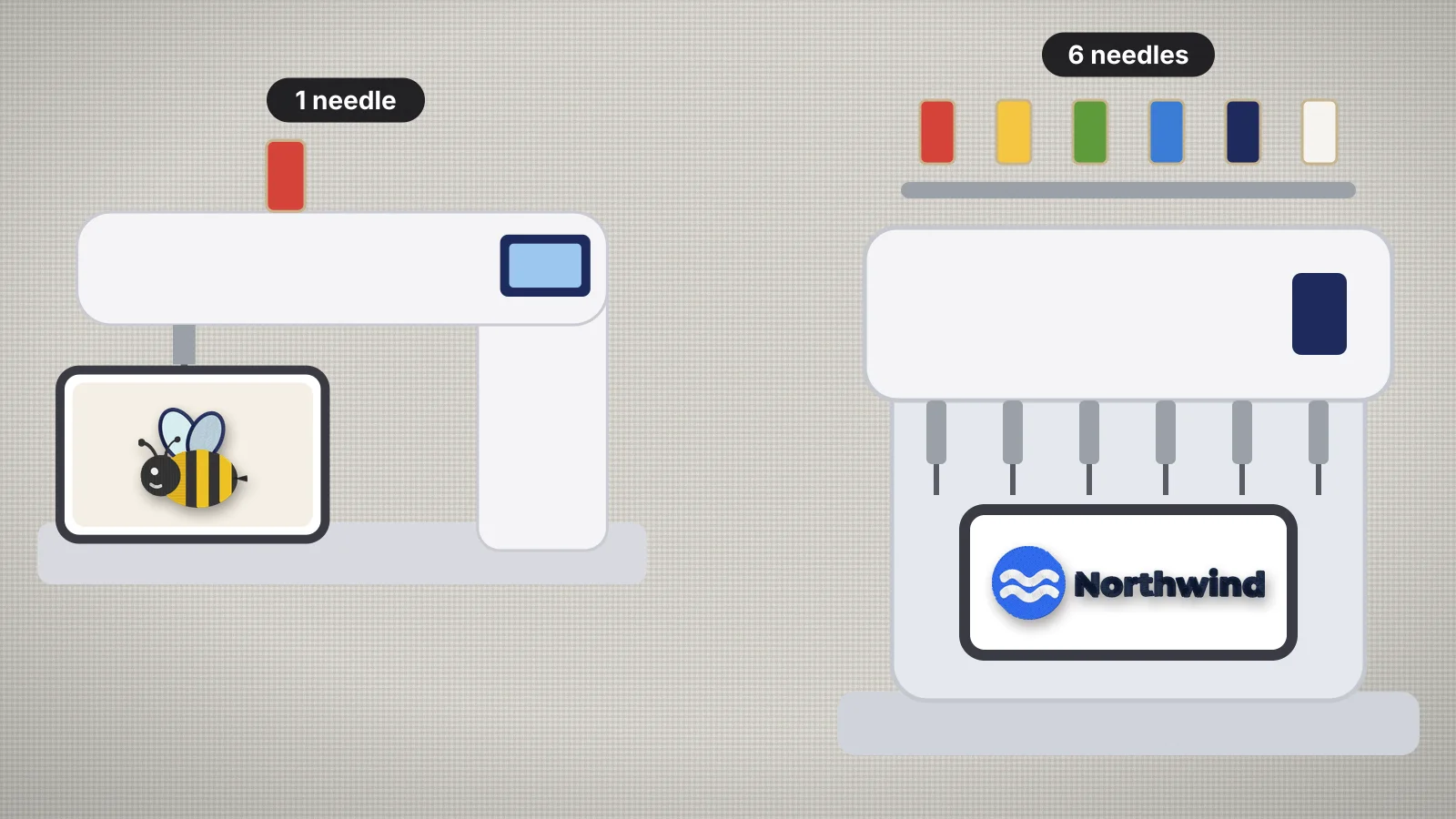
The biggest split in embroidery machines isn't the brand or the hoop size. It's the number of needles. A single-needle machine sews one color, stops and waits for you to rethread. A multi-needle machine has a row of needles, each threaded with its own color, and moves between them on its own.
That one difference changes how long a job takes, how you work, what you can hoop and who the machine suits. This guide compares the two with real models, using the makers' published specs summarized on the machine pages, and the machine comparison chart puts every model side by side. Models and accessories change between years and countries, so check the details with a dealer before you buy.
Single vs multi-needle at a glance
| Consider | Single-needle | Multi-needle |
|---|---|---|
| Color changes | Manual: the machine stops and you rethread for each color | Automatic: each needle holds its own color |
| Needles | One | From 6 on the Brother PR680W to 16 on the Melco SUMMIT, among the models on these pages |
| Top speed | About 650–1,050 stitches a minute on the models here | About 800–1,500 stitches a minute on flat items, on the models here |
| Largest field | From 4×4 in (100 × 100 mm) on entry models to 350 × 360 mm on the Pfaff creative icon 2 | From 240 × 200 mm on the Janome MB-7 to 500 × 360 mm on the Ricoma MT-1501 |
| Caps, sleeves and bags | Hooped flat or floated; a free arm on a few models | Tubular frames and cap frames on many models |
| Sews garments too | Many are sewing and embroidery combos | No: embroidery only |
| Best for | Hobbyists, gifts, names and small runs | Shops, team orders, workwear and repeat runs |
The speeds overlap more than you might expect: the Baby Lock Alliance, a single-needle machine, lists a top speed of 1,000 stitches a minute, the same as the six-needle Brother PR680W. The time a multi-needle machine saves comes mostly from color changes and hooping, not from stitching faster.
Color changes: the real difference
On a single-needle machine, each color change means the machine stops, you cut the thread, take the next color through the whole thread path and the needle, and restart. That takes a minute or so each time. For one gift with three colors it hardly matters; across an order it adds up fast.
Take 24 polos with a six-color logo. On a single needle, each shirt needs the colors threaded in turn, about six thread changes a piece, or around 140 for the order. At a minute each, that's more than two hours of rethreading. A multi-needle machine with six or more needles is threaded once, and it switches colors itself on every shirt.
- More colors than needles? The machine stops and you rethread a needle, so a design with more colors than your machine has needles still needs some manual changes.
- Set the needles from the color sheet. DST files, the usual format for multi-needle machines, store no thread colors. The embroidery run sheet turns a stitch file into color stops with needle numbers.
- Keep common colors on the same needles, such as black, white and navy, so jobs need fewer changes at the thread stand.
The glossary entry on color changes explains how files mark them, and the production calculator adds color changes, trims and hooping to the sew time on one or more heads.
Try it with your own design
Sign up free, upload an image and get a stitch preview in under a minute.
Drop your image here
PNG, JPG, WebP or SVG · stays on your device
Speed and day-to-day workflow
| Machine | Needles | Top speed, from the maker's specs |
|---|---|---|
| Janome Memory Craft 230E | 1 | 650 stitches a minute |
| Janome Skyline S9 | 1 | 800 stitches a minute |
| Baby Lock Alliance | 1 | 1,000 stitches a minute |
| Baby Lock Journey | 1 | 1,050 stitches a minute |
| Janome MB-7 | 7 | 800 stitches a minute |
| Brother PR680W | 6 | 1,000 stitches a minute |
| Ricoma MT-1501 | 15 | 1,200 stitches a minute |
| Melco SUMMIT | 16 | 1,500 stitches a minute on flat items, 1,200 on caps |
- Hoop the next piece while one sews. With spare hoops you can do this on either kind of machine, but it pays off most on a multi-needle machine that runs without stopping for colors.
- Less babysitting. A single-needle machine needs you at every color stop; a multi-needle machine mostly needs you for thread breaks, bobbin changes and the next hooping. Some machines send alerts: Brother's My Stitch Monitor app tells you when the PR680W needs a thread change or has finished, and the BERNINA Stitchout app reports thread breaks, an empty bobbin and color changes on the single-needle Bernina 790 PRO.
- Caps sew slower. Makers often give a lower top speed for caps: Brother does for the PR1055X, and Melco lists 1,200 stitches a minute on caps for the SUMMIT.
- More heads, more output. Shops add heads or machines as orders grow, and the production calculator shows pieces per hour on one or more heads.
Hoops, caps and tubular items
Most single-needle machines are flatbed: the hoop slides over a flat bed, so whatever you stitch has to lie flat around the hoop. That's fine for flat fabric, quilt blocks and the front of a shirt, and harder for caps, sleeves, bag fronts and anything tubular, which have to be hooped flat, floated or opened up. A few single-needle machines have a free arm, such as the Baby Lock Alliance.
Multi-needle machines usually have a free arm, so tubular items slip over it: sleeves, finished bags and the crown of a cap. Many take tubular hoops and cap frames:
- The Tajima SAI takes large (200 × 300 mm) and small (100 × 100 mm) tubular frames, with a cap frame as an option.
- The Ricoma EM-1010 ships with two cap rings, a cap driver and a hoop station for caps.
- The Melco SUMMIT's wide-angle cap frame sews 14.1 × 3.25 in.
- The Brother PR680W takes hoops from 1.5 × 2 in up to 8 × 12 in.
If caps are a big part of what you'll make, a machine with a cap driver is the main reason to go multi-needle. On a single-needle machine, unstructured caps can be hooped flat or floated, and some models offer a small cap frame accessory. The hat embroidery guide and the cap frame entry explain the options.
Real models side by side
| Machine | Type | Needles | Largest field |
|---|---|---|---|
| Brother PE800 | Embroidery-only | 1 | 5×7 in (130 × 180 mm) |
| Brother NQ1700E | Embroidery-only | 1 | 6×10 in (160 × 260 mm) |
| Janome Memory Craft 500E | Embroidery-only | 1 | 200 × 280 mm |
| Brother SE1900 | Sewing and embroidery | 1 | 5×7 in (130 × 180 mm) |
| Janome MB-7 | Multi-needle | 7 | 240 × 200 mm |
| Brother PR680W | Multi-needle | 6 | 8 × 12 in (200 × 300 mm) |
| Tajima SAI | Multi-needle | 8 | 200 × 300 mm |
| Ricoma EM-1010 | Multi-needle | 10 | 310 × 210 mm |
| Ricoma MT-1501 | Multi-needle | 15 | 500 × 360 mm |
The comparison pages set pairs side by side from the makers' specs. Among multi-needle machines: PR680W vs Janome MB-7, PR680W vs Ricoma EM-1010, Tajima SAI vs PR680W and Ricoma EM-1010 vs MT-1501. Among single-needle machines: PE800 vs NQ1700E and PE800 vs Janome Memory Craft 500E.
Which one suits you
| If you | Choose | Why |
|---|---|---|
| Make gifts, names and baby items, a few pieces at a time | Single-needle | It costs far less, and thread changes are a small share of the time on one-offs |
| Also sew garments and quilts | A single-needle sewing and embroidery combo | One machine for both, such as the Brother SE1900 (5×7 in, 240 sewing stitches) |
| Sell personalized items, mostly one at a time | Single-needle, ideally with a 5×7 in field or larger | Names and monograms are often one or two colors |
| Run team, school or workwear orders | Multi-needle | Automatic color changes and pre-hooping keep repeat orders moving |
| Embroider a lot of caps | Multi-needle with a cap driver | Structured caps are much easier on a cap frame |
| Are testing a business idea | Start single-needle and move up when orders are steady | Prove the demand before the bigger investment |
Some shops end up with both: a multi-needle machine for production and a single-needle machine for one-offs and samples. The business guide covers when the move pays off, the business calculator estimates payback, and the buyer's checklist covers field size, formats and transfer.
Files for each kind of machine
Both kinds of machine sew the same kind of stitch file; only the format differs. Home single-needle machines read their brand's format, such as PES for Brother and Baby Lock or JEF for Janome, and many read DST too. Multi-needle machines mostly use DST, and many read the maker's own formats as well:
- The Brother PR680W reads PES, PHC and DST.
- The Janome MB-7 reads JEF, JEF+ and DST.
- The Tajima SAI reads DST and TCF, and the Ricoma EM-1010 reads DST and DSB.
- The Melco SUMMIT reads OFM, EXP, DST and ARTX.
A design made for one kind of machine sews on the other, as long as it's in a format the machine reads; the PES vs DST guide explains the difference that matters most, thread colors. The digitizer writes DST, PES, JEF, EXP, VP3, XXX, PEC, U01 and TBF, so one design covers both kinds of machine. Digitizing and previewing are free with your account; downloads need a plan, from $8 a month billed yearly.