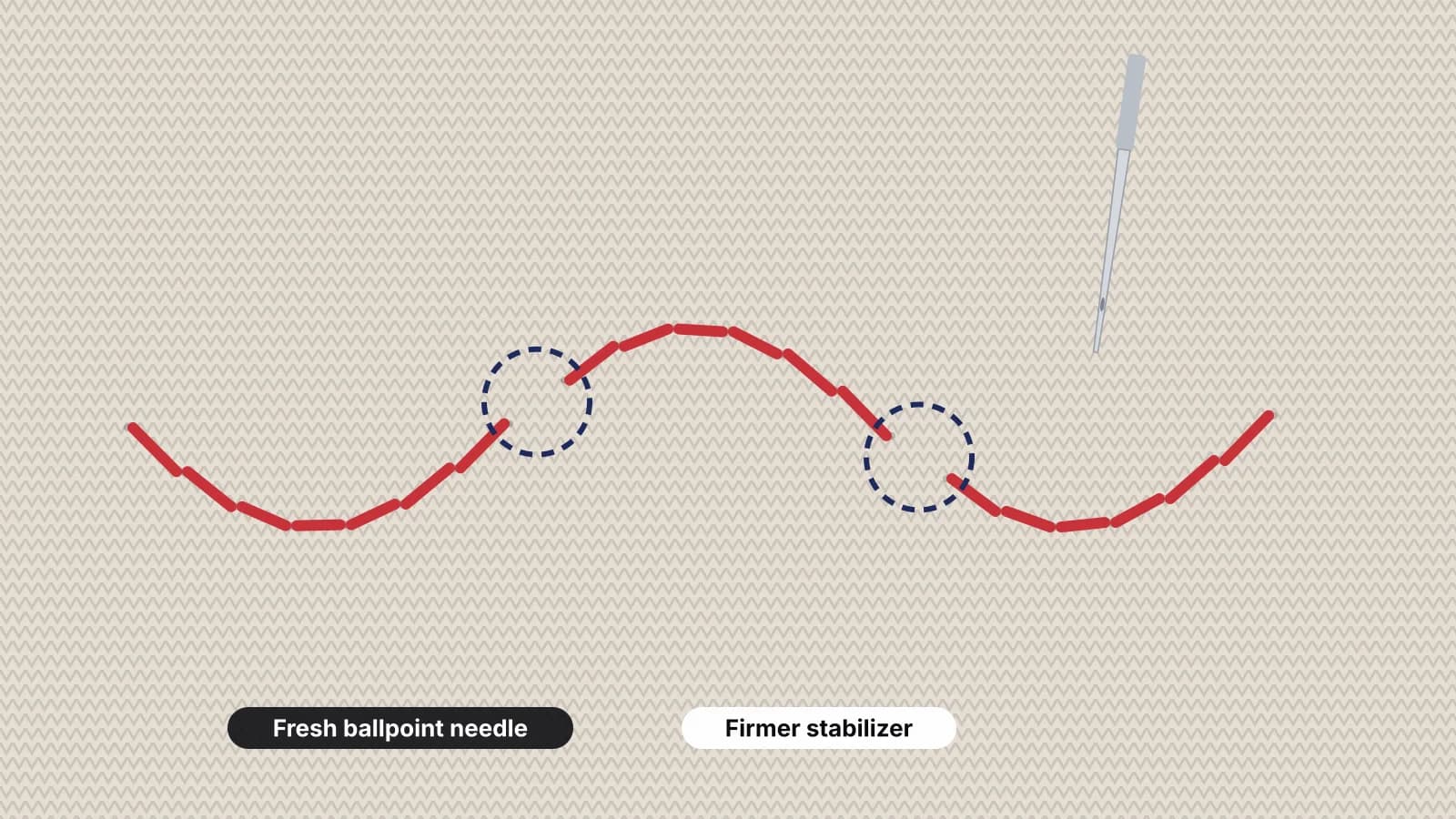
A skipped stitch is a gap where a stitch should be: the needle went down and came back up, but the top thread didn't lock with the bobbin thread. In embroidery it shows as long, loose stitches in a satin column, a broken outline, or lettering that looks ragged along one edge.
Skipping almost always has a cause near the needle, and the fixes are quick to try. This guide explains how a stitch forms, then works through the needle, threading, flagging fabric, stabilizer, thread and speed, and finally timing, which is a job for a technician.
How a stitch forms, and why it gets skipped
As the needle starts to rise from its lowest point, the top thread forms a small loop beside the needle's eye. The hook sweeps past, catches that loop and wraps it round the bobbin thread. Anything that stops the loop forming, or moves it away from the hook, makes a skip:
- The needle is the wrong type, size or position, so the loop forms in the wrong place.
- The fabric lifts with the needle, called flagging, so the loop collapses before the hook reaches it.
- The thread isn't feeding smoothly, or is caught somewhere along its path.
- The timing between needle and hook is off, so the hook arrives too early or too late.
Start with the needle
| Problem | Fix |
|---|---|
| Dull, burred or bent | Fit a new one; many embroiderers change needles every 8–10 hours of stitching |
| Not pushed fully up | Reinsert it all the way into the clamp; on most home machines the flat side of the shank faces the back |
| Wrong system | Use the needle system your manual lists; commercial machines often take a different system, such as DBxK5, from home machines |
| Wrong point for the fabric | A ballpoint on knits and performance fabric; a sharp on wovens, caps and leather |
| Wrong size | 75/11 for most work with 40-weight thread; 65/9 or 70/10 for fine thread and light fabric; 80/12 or 90/14 for heavy fabric |
| Adhesive on the needle | Spray adhesive and sticky stabilizer gum the needle; clean or replace it, or switch to titanium needles |
Stretchy and performance fabrics are a classic cause of skips with a sharp needle: the point pushes the fabric down instead of passing between the fibers, and the loop doesn't form. A ballpoint often fixes it. The needle guide covers sizes and points.
Try it with your own design
Sign up free, upload an image and get a stitch preview in under a minute.
Drop your image here
PNG, JPG, WebP or SVG · stays on your device
Threading and the thread path
- Rethread from the spool with the presser foot up, so the thread seats in the tension discs and passes through the take-up lever.
- Check the thread isn't caught on the spool's notch, wrapped round the spool pin or snagged on a guide.
- Thread the needle the way the manual shows, which on most home machines is front to back.
- Reseat the bobbin and check the bobbin thread is in its tension spring.
- Clean out lint round the hook and the bobbin case; the maintenance guide shows how.
The threading guide walks through the whole path, top thread and bobbin.
Flagging and loose hooping
If the fabric bounces up and down with the needle, the thread loop can't form properly and stitches are skipped, often in patches. It's most common on knits, thin and stretchy fabrics, caps and items that are floated rather than hooped.
- Hoop the fabric and stabilizer together, firmly. The fabric should be smooth and taut in the hoop without being stretched.
- Use the smallest hoop that fits, so there's less loose fabric to bounce.
- Add stabilizer, or use a firmer one, and bond slippery or stretchy fabric to it with a fusible backing or spray adhesive.
- When you float, use a sticky stabilizer and baste the fabric down round the design. The floating entry covers the method.
- On caps, pull the cap tight on the frame and make sure the backing fills the front panel; caps flag more easily than flat items.
- Check the presser foot height on multi-needle machines. Set too high, it doesn't hold the fabric down as the needle rises.
The hooping guide and the stabilizer guide go into detail.
Thread, speed and the design
- Old or poor-quality thread with thin spots and lint can skip as well as break. Try a fresh spool of embroidery thread.
- Metallic and specialty threads form loops less reliably. Slow the machine down and use a metallic or large-eye needle.
- High speed on thick or stretchy items makes skips more likely; slow down.
- Very short stitches in a file can be skipped or bunched up. The short stitches entry explains why digitizers avoid them.
- Very long satin stitches can sag and snag and look like skips. The Embrizo digitizer splits satin stitches longer than 7 mm automatically.
To see whether a file has problems in the spot where the skips appear, open it in the embroidery file checker, which flags long and tiny stitches. If you're making the file from artwork, the digitizer shows a stitch preview and sew-out first; digitizing and previewing are free with an account, and downloading the file needs a paid plan.
Practice on a free design
124 ready-to-sew designs in every machine format, free with an account.



When it's the timing
If a new needle, rethreading and firm hooping don't stop the skips, especially on several fabrics, the hook timing may be out. It can be knocked out by a needle strike, a hard jam or thread wrapped round the hook. Signs include:
- Skips that started right after a needle broke or the machine jammed.
- Skips on every fabric, with every fresh needle you try.
- A knocking or clicking sound from the bobbin area.
- The needle touching the hook or the bobbin case.
Setting the timing means taking part of the machine apart and adjusting it precisely, so book a service with a technician or your dealer. The embroidery troubleshooter helps rule out the simpler causes first.