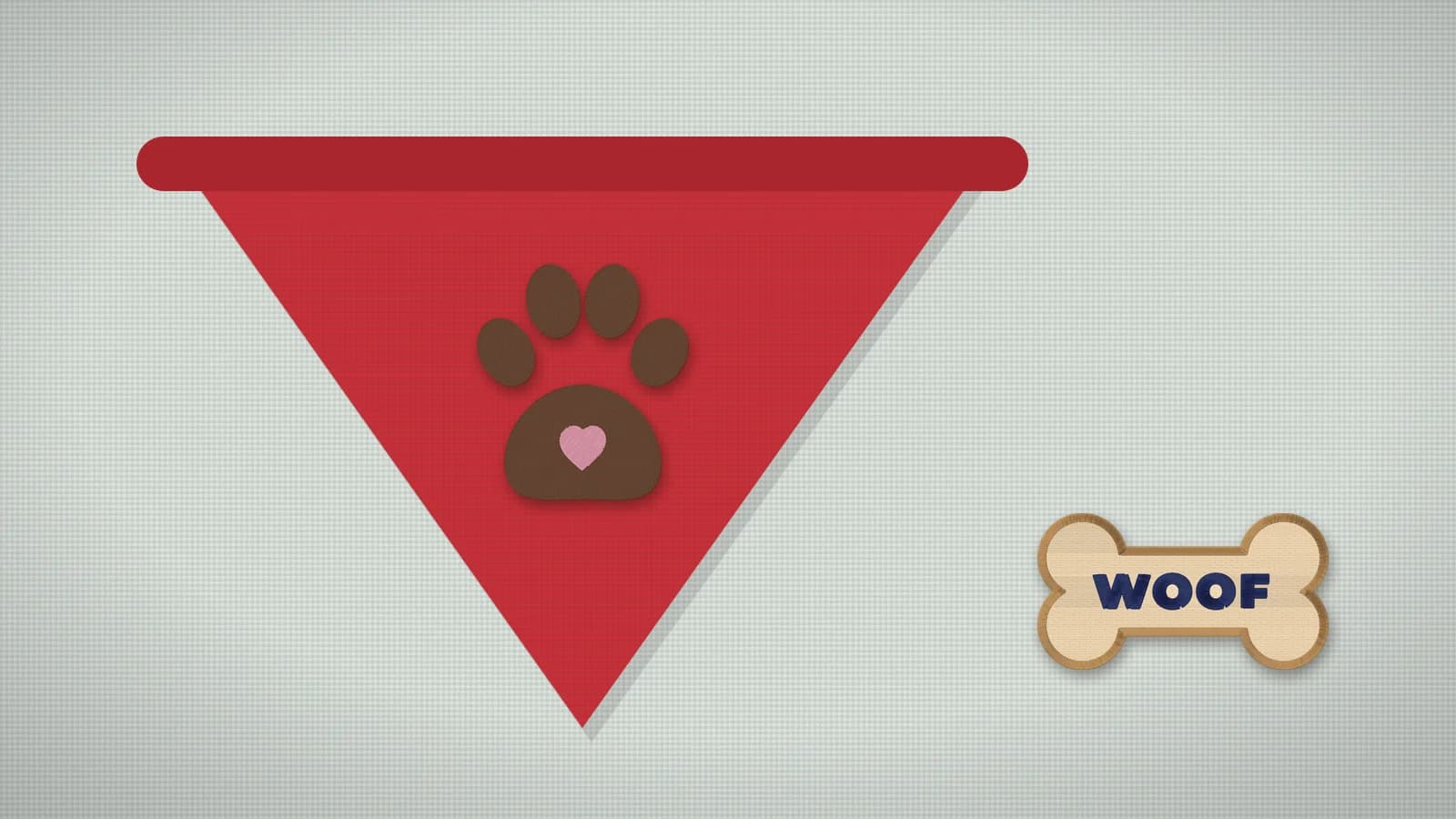
A bandana is one of the quickest pet projects: a triangle of fabric, a name or a paw print, and a dog or cat dressed up for the photos. It's also something an animal will scratch, chew and roll in, so the finish matters as much as the design.
This guide covers stitching before or after cutting, placement and names, sizes by pet size, fabrics, stabilizer and lining, safety, and designs. For more pet projects, see the pet embroidery ideas.
Embroider before or after cutting?
| Bandana | Best approach | How |
|---|---|---|
| Sewing your own tie-on bandana | Embroider first, then cut | Stitch on a square larger than the pattern, then cut the triangle round the design |
| Over-the-collar bandana | Embroider the front panel before sewing the collar channel | Once the channel is sewn, the panel is hard to hoop |
| Ready-made bandana | Hoop the point, or float it | Hoop the point with stabilizer, or float it on sticky stabilizer if it's too small to hoop |
| Lined or reversible bandana | Embroider the outer layer before lining it | The lining hides the back of the stitching |
- Cutting after stitching gives the hoop fabric to grip and lets you center the triangle on the design exactly.
- Mark the pattern on the fabric first, with the point and the top edge, so the design lands where it'll show.
Placement and names
- Center it toward the point. On a tie-on bandana the point hangs on the chest and the top edge wraps round the neck. Center the design on the line from the point to the middle of the top edge, in the lower half of the triangle, so it isn't lost in the knot or under the chin.
- Turn it the right way up. The top of the design faces the bandana's top edge, so it's upright when the pet faces you.
- Names: a short name in Block or Rounded capitals, about 15–25 mm tall on most dogs, reads from across a room. Scripts need about 10–12 mm or more and look best on bigger bandanas.
- Name plus motif: a paw print or dog bone beside or under the name. The combining guide covers gaps and order.
On an over-the-collar bandana, center the design on the front panel, below the channel.
Try it with your own design
Sign up free, upload an image and get a stitch preview in under a minute.
Drop your image here
PNG, JPG, WebP or SVG · stays on your device
Sizes by pet size
Bandana patterns vary, so measure the neck where the collar sits, add room to tie it or slip it over the collar, and size the design to the triangle. As a rough guide:
| Pet | Neck, roughly | Design width |
|---|---|---|
| Cat or extra-small dog | 8–12 in (20–30 cm) | About 1.5–2 in (40–50 mm) |
| Small dog | 12–16 in (30–40 cm) | About 2–3 in (50–75 mm) |
| Medium dog | 16–20 in (40–50 cm) | About 3–4 in (75–100 mm) |
| Large dog | 20–26 in (50–65 cm) | About 4–5 in (100–125 mm) |
| Extra-large dog | 26 in (65 cm) and up | About 5–6 in (125–150 mm) |
Small designs fit a 4×4 in hoop; larger names and motifs need a 5×7 in hoop or bigger. The hoop size calculator checks a design size against every standard hoop.
Cotton, flannel or fleece
| Fabric | Why choose it | Backing | Needle |
|---|---|---|---|
| Quilting cotton | Light, washable, bright prints; the most common choice | Medium tear-away, or light cut-away for dense designs | 75/11 sharp |
| Flannel | Soft, warm and slightly fuzzy | Medium tear-away or light cut-away, with a topping for small text | 75/11 sharp |
| Fleece | Warm for winter walks, and doesn't fray | Cut-away, with a water-soluble topping | 75/11 ballpoint |
| Denim or chambray | Hard-wearing, with a casual look | Medium tear-away | 80/12 sharp, or 90/14 on heavy denim |
| Performance knit | Light and quick-drying | No-show mesh or light cut-away, hooped without stretching | 70/10 or 75/11 ballpoint |
Prewash cotton and flannel, which can shrink in the first wash and pucker round the stitching. The stabilizer guide explains each backing, and the denim stabilizer page has more on denim.
Stabilizer, lining and a soft back
- Soft against fur. Tear-away removes cleanly and leaves little behind. Cut-away stays in and can feel stiff on a small bandana, so trim it close and round its corners.
- Line it. A lined or double-layer bandana hides the back of the embroidery, the bobbin thread and the backing, and is softer against the neck.
- Wash-away for unlined bandanas where the back shows: fibrous water-soluble stabilizer rinses out and leaves nothing to scratch, on stable cotton with light designs.
- Topping on fleece and flannel keeps a name crisp; tear and rinse it off afterwards.
- Pick the fabric preset in the digitizer: Woven for cotton, flannel and denim, and Fleece, towel, sweatshirt for fleece.
Keeping it safe for pets
- No loose threads. Trim every jump thread and thread tail close, on the front and the back. A loose loop can catch a claw or a tooth and pull the stitching out.
- Lock stitches matter. They stop the stitching unraveling after each trim; Embrizo adds short lock stitches to the start and end of each stitch run.
- Avoid long satin stitches. Satin wider than about 7 mm lies loose and snags, so sew wide shapes as fill.
- Nothing to chew off. Skip buttons, beads, sequins and glued charms on pet bandanas.
- Fit it loosely. You should be able to slide two fingers under a tied bandana. For cats, an over-the-collar bandana on a breakaway collar is usually the safer choice.
- Supervise. Many owners only put a bandana on while the pet is supervised, and take it off for crates and rough play.
Check the bandana after every wash, and retire it if the stitching starts to loosen. The jump stitch entry explains where loose threads come from.
Practice on a free design
114 ready-to-sew designs in every machine format, free with an account.
Designs for pet bandanas
The free pet designs fit a 4×4 in hoop and download free with an account:
- For dogs: paw print, dog bone and puppy.
- For cats: cat and fishbowl.
- More: the pet designs, and seasonal designs such as a snowflake or a pumpkin for holiday bandanas.
For a drawing of your own pet or a groomer's logo, upload the artwork to the digitizer, set the width to suit the bandana and preview the stitches. Digitizing and previewing are free with an account. Selling bandanas? Batch name embroidery turns a list of pet names into lettering files in the same font and height; saving them needs a paid plan.